Sunday, October 11, 2015

Phil Vischer and the Theology of Jellyfish

Originally posted on my Watching God blog on Patheos.
Phil Vischer has always been one of my favorite storytellers. My kids drew up watching Vischer’s VeggieTales—a rare faith-based product that was both seriously Christian and delightfully entertaining—and he’s continued telling stories through his JellyTelly characters, headed by the intrepid big-headed puppet Buck Denver.
But his latest feels like one of the most personal stories he’s told yet.
“You might even call it autobiographical,” Vischer told me.
1008galaxybuckIn Galaxy Buck: Mission to Sector 9 (available onOct. 11 here and lots of other places), Buck has made a career change—from “Man of News” to a phone jockey in a galactic parachurch ministry. And while one should never look down’s one bulbous felt nose at gainful employment, Buck does bridle at spending his days in a non-descript cubicle. He keeps a poster that says “God wants you to do big things,” and he just doesn’t think shipping out tote bags really fits the “big things” bill.
But when he gets the chance to do something really big—hop in a spaceship with his own fearless crew to fix a transmitting station on an (ahem) uninhabited planet—things go Martian in a hurry. A sandstorm whips up. His crewmates disappear. A critical transmitter component is oddly missing. And Buck soon finds himself in the company of a strange, old hermit who promptly tears Buck’s prized poster in two.
He gives the top half—the half that says “God wants you”—back to Buck.
“I need the other half,” Buck says.
“No you don’t,” the hermit insists.
And he takes Buck on a tour of his jellyfish farm—suggesting that it’s the jellyfish who get what we Christians are supposed to be doing. We’re supposed to float on the current of God’s love and take it to where He takes us. Buck doesn’t need to stress himself out over the need to do “big things” for God. God isn’t interested in our performance. He’s just interested in us.
Vischer knows all about trying to do big things for God. VeggieTales, the core product of Vischer’s Big Idea Entertainment, was a runaway phenomenon in the late 1990s. But the company eventually collapsed—a history that Vischer himself unpacks in ablog. “I wanted to build the next Disney,” he wrote in 2004. But to achieve this—to do this “big thing”—required more money, more people, more effort and, as it turns out, a great deal more debt. Eventually the whole thing fell apart after the release of Jonah: a VeggieTales Movie. Big Idea went into bankruptcy and the VeggieTales brand was sold.
“Following God starts with a relinquishment of your own ego, your own goals,” Vischer says. It was a painful lesson, and one he shares in talks at churches and college campuses across the country. Now, he’s teaching the same lesson to the children and families he’s been reaching for most of his adult life, using it as a counterbalance to one of the culture’s most seductive themes.

1008 phil vischerChildren’s programming is often replete with messages about following your dreams, according to Vischer. “There’s the assumption in there that if I want it, it must be good,” he says. “But just because I want something, is it automatically good for you?” Even kids get that that’s not true, Vischer adds, “but once we start using the language of dream, there’s a moral implication.”
Vischer’s trying to simply hang out in the current of God’s love these days: No accident that he calls his new business Jellyfish Labs. And instead of spending months and months crafting a computer-animated VeggieTales story, Buck Denver and his gamut of puppets allow him to turn things around much more quickly and be a bit more spontaneous, too—particularly in his popular podcasts.
He talks about the four years and the millions of dollars he and his team spent makingJonah. When it was all done, the team still had to piece together some extras for the DVD—including an audio commentary featuring Mr. Lunt (voiced by Vischer) and Larry the Cucumber (Mike Nawrocki).
“We ad-libbed the whole thing,” Vischer says, “and it was funnier than the movie was!”
‘Course, being funny isn’t something that Christians always do well, even Christian entertainers. And Vischer admits that it’s a ticklish thing to pull off. “People who make Christian films are usually deadly serious,” he says. They go into their stories hoping to save audiences from hell itself.
I’ve got to save them,” Vischer says, stepping into the shoes of a Christian storyteller, “and hey, that made me just think of something funny!
It makes what Vischer does all the more remarkable, I think.
“I’m not a pure storyteller,” he admits. “I would have a hard time writing a novel—500 pages with some hinted-at lessons.”
Which is fine. As Buck Denver himself might say, God doesn’t call us all to write big books. But Vischer, as a hybrid teacher and storyteller, has found a nice sweet spot for himself, has made a pretty big difference.


Sunday, October 4, 2015

The Walk: A High-Wire Act That’s Not About Faith (But Sort of Is)

This was originally posted on my Patheos blog, Watching God.
When I was youngish, a friend of mine and I went to check out the Black Canyon of the Gunnison during a camping trip. It looks something like this.
0930 BlackCanyon
Photo courtesy Wikimedia
Very pretty, yes? But it’s also a long way down from the ridge of the canyon to its rocky, watery bottom. A really, really long way down. So my friend and I—brave, stupid fellows who once tried to break through the ice on a lake while standing on it—literally crawled on our hands and knees to look over the edge. Heights are not really our thing.
This made me, perhaps, not the best person to see The Walk.
The Walk, for those of you who don’t know, is based on the true story of Frenchman Phillippe Petit’s illegal 1974 high-wire performance between World Trade Center towers. In real life, Petit spent about 45 minutes on that wire, walking and kneeling and lying down on a thin cable of steel 110 stories above the Manhattan streets. In the movie, it felt like a couple of weeks. It’s intended, I think, to be a film saluting Petit’s bravery, ingenuity and sheer stubborn will. Given my mild acrophobia, I just wanted the guy to get caught before he even started his walk. The ground’s not so bad, Phillippe. Really.
Had I been thinking about how this little tightrope stunt would impact me—in 3-D IMAX, no less—I would’ve brought in a bottle of Tums.
This is not a knock on the movie. Really, it illustrates just how effective it is. And even for me, the flick had some pretty beautiful moments in it.
0930 the walk 1
Joseph Gordon-Levitt in The Walk
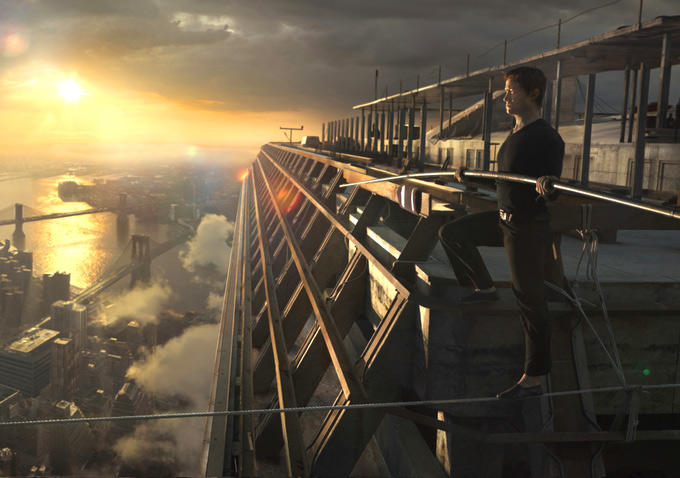
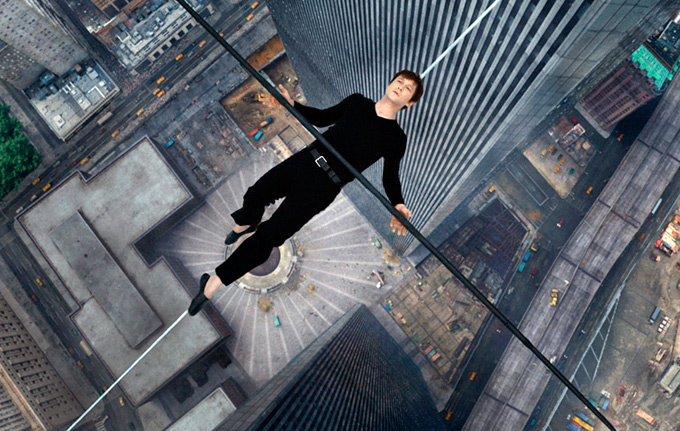
For instance, the moment when Petit (played by Joseph Gordon-Levitt) first steps onto the wire stretching between the two towers. Clouds envelop the scene, and the wire vanishes in a blue-cotton haze in the distance. Petit speaks of the comfort that comes from placing his foot on the wire—how it supports him, how the towers support the wire.
And in that moment, it felt like a picture of faith.
Faith and tightrope walking, oddly enough, have a strange, shared history. Nik Wallenda, the tightrope walker who walked over Niagara Falls in 2012, is a Christian whose faith is instrumental in his work. “I grew up in a born-again Christian family,” he told QMI Agency at the time. “That’s the way I was raised and I find comfort and peace in that.” Loads of preachers have recounted the story of another famed French tightrope walker, Charles Blondin, who walked across the falls in 1860. He allegedly performed many great feats on that line, including pushing a wheelbarrow full of potatoes across it.
“Do you believe I can carry a person across in this wheelbarrow?” he allegedly asked the crowd gathered at the edge of Niagara Falls. “Yes!” the crowd shouted. But when he asked for volunteers, not a one of them took Blondin up on the trip.
It’s an illustration, pastors say, of a weak faith: We say we believe, but do we? Do we really?
I thought of that illustration as I watched the end of The Walk—Petit held up by this thin cord. Petit trusted. He had faith.
It was not a blind faith: He calculated the weight of the wire needed, the stabilizers it would require, all manner of eventualities. He’d been a tightrope walker for years, even practicing on wires that his friends would tug and yank, replicating the high winds he might expect 110 stories up. He trusted his skills, his equipment, his friends.
But the stunt required a severe, unblinking sort of faith even so. Any sensible man might still look at the wire—stretched nearly 1,400 feet up in the air—and grow fearful. I mean, how could a sensible man not? But Petit was taught by his mentor, Papa Rudy (Ben Kingsley), that fear and doubt mean death. When Petit feels an inkling of doubt during his training in the movie, the wire shakes and buckles. Sometimes, Petit falls. He has the skills to make it across, no doubt. But if he doubts his skills? Loses heart in the moment? If he lets the wire’s height or length get to him? There’s no way Petit would make it across.
“It’s impossible,” Petit says. “But I’ll do it.”
0930 the-walk-joseph-gordon-levitt
Joseph Gordon-Levitt in The Walk
I was reading a story the other day bySalon’Darin Strauss about how difficult it is, in this age of rationality, to have faith. “How, against a contemporary background, do you contemplate the almighty?” he wrote. “Who believes there’s an oasis in 2015’s scattered metaphysical sand?” Some say that it’s impossible to believe in God today. Foolish, perhaps. The ground’s not so bad.
But yet, those of us who believe in God feel our faith underneath our feet, holding us up. We feel the strength of what our faith is attached to. This is not a strange, frightening place; it is life itself. We believe. And we walk.
“The wire is a safe place for me to be,” Phillippe Petit once said. “It’s a rigorous and simple path. It’s straight. You don’t have meanders like, you know, on the ground, in life.”
Funny how walking as a Christian is often characterized in the same way. Rigorous. Simple. Straight.
I can’t claim to be free of fears or doubts. If my faith is a wire, it sometimes shakes. I sometimes fall. But I do have faith—faith that something special is waiting on the other side.

Sunday, September 20, 2015

The Season of the Sorta-Secular Christian Movie

Originally published at my Watching God blog at Patheos.org.
Last year was called the year of the faith-based movie, and in a lot of ways, it was. Three straight-up Christian flicks (Heaven is for Real, God’s Not Dead and Son of God) each made more than $50 million. Another two movies theoretically made with a faith-based audience in mind—Noah and Exodus: Gods and Kings—banked even more. Only problem: Secular audiences had no use for the former, and most evangelical Christians kinda hated the latter.
This fall, though, we’re about to see a different sort of faith-based movie in theaters. And it’ll be an interesting gauge whether Christians can get excited about “Christian” movies that don’t feel like Christian movies.
captive
Kate Mara and David Oyelowo in Captive
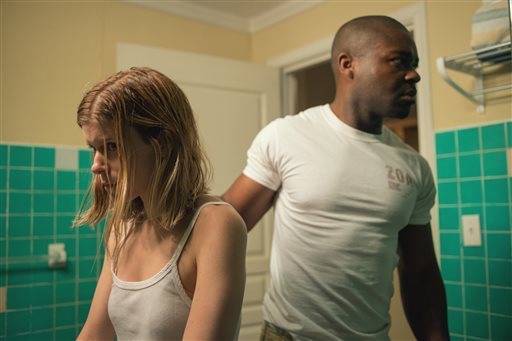
Up first: Captive, released this very day. The movie’s stars, David Oyelowo (who was robbed of an Oscar nom in Selma), and House of Cards’ Kate Mara, aren’t the sort you’d expect to show up in a Christian movie—but then again, this doesn’t feel like your typical Christian movie, either.  It’s a rough, story dealing with messy subjects and involving not a small amount of tension. Yet Captive is unquestionably a Christian story—so ridiculously Christian, in fact, that most faith-based filmmakers would’ve rejected it out of hand for being way too improbable had it not been absolutely true.
In 2005, Brian Nichols (Oyelowo)—on trial for rape—escaped from an Atlanta courthouse, killing four people en route to the apartment of Ashley Smith (Mara). He held Smith hostage for seven hours, and no one would’ve been surprised had he killed her, too. But during their time together, Smith read portions of Rick Warren’s Christian bestseller The Purpose Driven Live, and he eventually let her go.
Oyelowo is an outspoken Christian. But he had no desire to make a typical Christian movie.
“Yes I’m a Christian myself, but I’m not particularly interested in quote-unquote preaching to the choir,” Oyelowo told the Los Angeles Times. “I am a big believer in the potency of artistic endeavor at its highest. To proselyte through your storytelling is not good storytelling.”
And then there’s The 33, to be released Nov. 13. It’s another true story, this one focused on the Chilean miners who were trapped in a mine for a staggering 69 days before they were finally—some would say miraculously—rescued.
It’s technically a secular movie, this one from Warner Brothers. Starring Antonio Banderas, Lou Diamond Phillips and Academy Award-winner Juliette Binoche, The 33has the pedigree of a solid independent film. But it doesn’t shy away from the deep faith of many of the miners (it even features a wayward miner finding salvation) or the fact that many saw divine providence in the rescue.
the-33
Antonio Banderas in The 33
“We realized we had only one alternative, and that was God Himself,” said miner Jose Henriquez, known by his fellow miners as “the pastor,” said at the 2011 National Prayer Breakfast in Washington D.C.
For a movie-lover like me, this is a pretty encouraging trend. While traditional Christian movies are getting better (and, obviously, some have even found financial success), most  are still not flicks you’d invite your agnostic friends to without blushing a bit.  And when secular studios try to woo Christians with big-budget epics and powerhouse directors (Darren Aronofsky directed Noah, and Ridley Scott helmed Exodus), they often show a certain tin ear when it comes to what most evangelical Christians actually want to see.
The fact that it’s a little hard to classify both of these movies as straight-up “Christian” or flat-out “secular” is encouraging, too. Captive is a Christian movie that honors the art. The 33 is a secular movie that honors the story’s intrinsic spiritual backbone. These fall movies not only take faith seriously, but they’re seriously watchable, too.
But will anyone watch them? These are smaller movies, after all—not superhero-laden blockbusters guaranteed to make 16 bazillion dollars. And while faith-centric moviegoers have shown a willingness to go to theaters if they have something to see, they can be a pretty persnickety bunch. And neither movie is as squeaky clean as some Christians demand.
“[Captive is] a little bit messy,” admits Captive co-producer Terry Botwick to the LA Times. “But that’s where the truth of it is.”
And that, I think, is often where the truth is often found: In the mess. Christianity was founded on a messy execution, after all. The world in which Jesus walked was hardly pristine. As Christians, I don’t believe that we’re supposed to ignore the grit and grime of the world, but rather see it clearly and do something about it.
Christian movies shouldn’t be needlessly gratuitous. But I’d argue they don’t need to be ruthlessly sanitized, either. There will always be space in Christian cinema circles for strong, clean, inspiring Christian stories. But I’m hoping there’s a future for unapologetic faith-based movies with a little grit, too.

Sunday, August 30, 2015

Attention Hollywood: Here’s What Moviegoers Actually Want to See

Originally published at my Watching God blog at Patheos.org.
It’s been a great year for women in movies. Check out the year’s 15 top-grossing films, and you’ll see that a majority of them—from Inside Out to toPitch Perfect 2 to Mad Max: Fury Road—feature strong women in leading roles.TimeForbes and io9 have all noted what a great year it’s been for girl power, and all I can say is, it’s about time.
How Hollywood ever got the idea that blockbusters have to be anchored by men is a little mystifying—particularly in an age where there are so many fantastic female actors out there who can bring depth and drama to any role. Here’s to hoping that Kate Blanchett gets her own action franchise.
But as the summer movie season comes to a close, there’s another trend to make note of.
Take a look at that Top 15 list. How many R-rated movies are on it? Two. Fifty Shades of Grey at No. 9 and Mad Max: Fury Road at No. 14.
How many R-rated movies have been released so far this year? About 126, according to Box Office Mojo—out of 226 total rated by the MPAA in 2015. That means more than half of Hollywood’s output (56%) has come in the form of R-rated movies.
Another illustrative, stat: The average R-rated movie in 2015 has made $12.1 million. MPAA movies rated G, PG or PG-13 rake in an average of $48.3 million.
Pitch Perfect 2
Pitch Perfect 2, Universal
Hollywood is beginning to understand that women can front big, successful flicks—and for their own well-being, it’s important that they do. The entertainment industry is a business, after all. It’s important to understand what people want to see.
So why so many R-rated movies?
Now, I’m not hating on the R. I believe that some stories, to be told well, need harsh content. Schindler’s List and 12 Years a Slave wouldn’t have had the same resonance without it. But I don’t buy that f-bombs and exposed intestines inherently make for good storytelling, either. In fact, I think gratuitous content is often used as a substitute for it.
When I watch old Hays code-era films—movies made between 1930 and 1968 under strict moral guidelines on what could be depicted onscreen—I don’t see stunted storytelling. I’d argue that, often, the restrictions in place enhanced it, forcing moviemakers to be more creative. Indeed, the Hays Code era encompasses many of the greatest films ever made. Don’t try to tell me that Citizen Kane would’ve been so much better with more swearing, or that Casablanca would’ve been more moving if we saw Rick and Ilsa in the sack. I don’t buy it.
Indeed, the less content a movie has, the better it does. There are five PG movies in the year’s Top 15: Inside OutMinionsCinderellaHome and The SpongeBob Movie: Sponge Out of Water. Only 15 G or PG movies received anything close to a wide release this year—and a full third of them are among the year’s most successful movies.
Cinderella
Cinderella, Disney
None of this is breaking news, of course. Since the Hays Code was abolished in 1968, moviemakers have always made far more R-rated movies than we’ve ever wanted to see. In 2013, the National Association of Theater Owners pleaded with Hollywood to turn down the R-rated spigots. “Make more family-friendly films and fewer R-rated titles,” said the organization’s President John Fithian. “Americans have stated their choice.”
Alas, the entertainment industry continues to chase the same mythical moviegoer that, I think, kept it from acknowledging the inherent draw of woman protagonists for such a long time: The 20-something male who likes his jokes profane, his women objectified and his cinematic action coated in a sheen of gore.
Do such men exist? Perhaps. But they’re not going to movies like they used to, apparently, and Hollywood’s never-ending pursuit of them leaves moviegoers like me—and perhaps like you—with fewer options than we’d like.

Sunday, August 16, 2015

Ricki and the Flash Shows Us What Courage Really Looks Like

There’s courage aplenty on the summer’s movie screens: Hey, there’s Ethan Hunt hopping on the side of a plane! Owen’s battling dinosaurs! Oooh, Scott Lang’s bravely shrinking for the sake of all humanity! Heroes are everywhere—risking their all for everything. And that’s great. Worthy, even.
But truth is, sometimes it’s easier to die for something than to live for it.
In Ricki and the Flash, the titular character (played by Meryl Streep) is an aging rocker, lost somewhere between a has-been
and never-was. She deserted her husband and kids to become a rock star. And even as she floundered, Ricki never looked back. She still plays music with her band, The Flash, in a small Tarzana, Calif., dive—checking groceries to pay the bills.
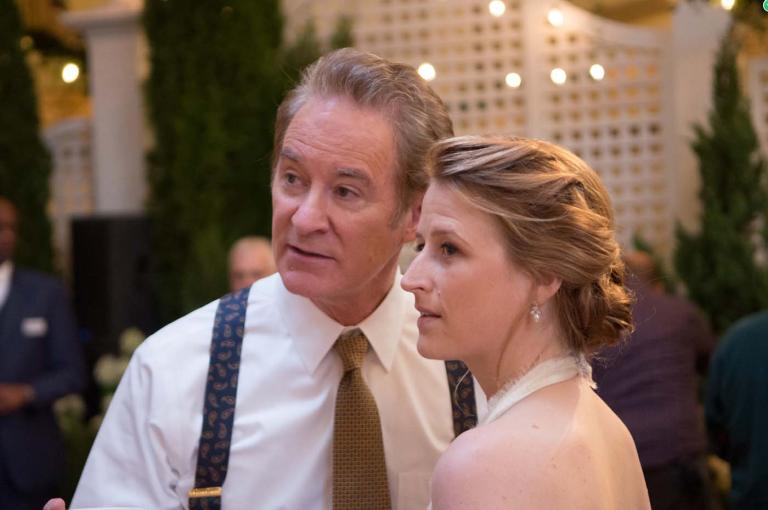
But when her daughter, Julie (Streep’s real-life daughter Mamie Gummer) tries to commit suicide, Ricki’s ex-husband, Pete (Kevin Kline) calls her home to Indianapolis. Once there, Ricki’s faced with a mountain of coulda-beens and shoulda-dones, confronting three children she hardly knows and who can barely stand the sight of her. “Guess you gotta give up a lot of special things to be a rock star,” Julie tells her.
Much of the movie is pretty discomforting—a litany of awkward dinners and embarrassing reunions, forced smiles and angry recriminations. And Ricki deserves everything she gets. She abandoned her family 20 years ago, and we can’t expect her kids to welcome her back as if nothing had happened. It’s not realistic. It’s not even fair. Not to her kids, anyway. Their mother made a really selfish, really bad decision that kinda crushed them. They have every right to be angry.
But here’s the thing: Ricki knows that. She didn’t come back for a joyous reunion. It’s not like she’s trying to kiss a 20-year-old boo-boo, making everything all better. She’s coming to help in the here and now—however her limited capital will allow her. She never really apologizes, but she accepts what she’s done. And she grieves.
When she confronts Julie’s ex—the catalyst to Julie’s attempted suicide—he lobs an emotional grenade. “Julie hates you,” he says.
“That may be,” Ricki says. “And I have to live with that every day of my life. But nowyou have to live with the pain you caused.”
Mistakes can be forgiven. Wounds heal. But the harm we do never just vanishes. We don’t get reset buttons.
We Christians talk a lot about forgiveness and redemption and all. It’s at the core of the faith, and one of the elements that makes it unique amongst all the world’s other great religions. But for those of us who have forgiven, and for those of us who’ve desperately needed forgiveness, the path to redemption and reconciliation isn’t always easy. Our religion doesn’t erase all the hurt, all the damage. Forgiveness isn’t just a matter of saying so. It’s a process—a long, hard slog for all involved, and with no pat promise of a happy ending. And there are times when Ricki wants to just … stop. To erase that chapter of her life completely. And she begins to wonder whether she’s worth loving at all. Take a look at this clip:

“It’s not their job to love you,” Ricki’s boyfriend Greg (Rick Springfield) says in the clip. “It’s your job to love them.”
It’s a great line. There are no exceptions to that, no conditions. “Hope bears all things, believe all things, hopes all things, endures all things,” Paul said. We love in the midst of pain, angst, discomfort. We love even when we want to run away.
It’s easy to tell someone we love that we’d die for them. It sounds very noble, very heroic, very Ethan Huntish. But as a friend of mine told me once, how many people get a chance to really make good on that promise? Not many. For most of us, the real trick is to live and love when we’re not loved back. Live and love in a painful situation. To face up to the consequences when we’ve done wrong. To walk on.
ricki 2That’s what Ricki tells Julie at Julie’s brother’s wedding. “Walk on,” she says, when it looks like Julie—overwhelmed, we assume, by memories of her own ruined marriage—is ready to bolt. And the thing that’s great about that moment? Ricki’s in a situation that she’d like to bolt from, too. She’s sitting in the back of her own son’s wedding, shunned and even laughed at by some of the guests. She feels totally unwanted, totally out of place. And yet, she’s there. She’s walking on—pushing through the shame and judgement and heartbreak of so many bad decisions. In that moment, she’s living in a nightmare built especially by her, for her. And she endures it all for the sake of her son.
People will say, and perhaps rightly, that Ricki and the Flash is overly sentimental, maybe manipulative. But for me the movie works, and this moment works beautifully. It’s a reminder of what love will, and should, endure. It shows us what real redemption—in the midst of real pain—looks like. And it depicts the sort of courage we rarely see in the movies—a courage that we might just have to find ourselves.

Sunday, March 29, 2015

Burning Bush 2.0: Two-Hundred Pages of Pop Profundity

I just got a box of books Friday. Not just of any book, but my new book—Burning Bush 2.0: How Pop Culture Replaced the Prophet. Abingdon Press, my publisher, won't be officially releasing it for another few weeks, so I guess that's one advantage of writing the thing. Early copies.

I’d like to think the book is a fun, fascinating, whirlwind trip through the world of popular entertainment, offering lots of quick-hit spiritual observations on everything from The Walking Dead and The Hunger Games to Skyrim and Despicable Me. I cover a lot of ground in Burning Bush: If my first book (God on the Streets of Gotham, Tyndale) was more like a leisurely stroll with Batman, this feels more like a pop-culture roller coaster. (“Hey, was that Epic Mickey?”) You’ll get a chance to see how geeky I can get, but there’s more to it than that. I also talk a little bit about the significance of story and entertainment in my own walk of faith, and I offer a little primer on how you can engage with entertainment with a more spiritual bent. And I even quote Monty Python.

I think you’ll like it. But I’m biased.

I’d like to give away a copy or two through the blog (after all, how many copies of the same book does one guy need?), but have no idea how to go about doing something like that. If you have any suggestions, let me know.

But if you don’t want to take your chances of getting a complimentary, signed copy from me, just order one online here or here. Better yet, order several. Hundreds. The folks over at Abingdon would, I’m sure, be very happy.

Sunday, March 1, 2015

St. Spock: Some Spiritual Thoughts on Leonard Nimoy’s Greatest Character

Leonard Nimoy died earlier today at the age of 83. He was, according to the obituaries I’ve seen, a man of many talents: poet, photographer, musician. But it was as an actor that most of us knew him first and best—an actor who became famous for one role. Mr. Spock of Star Trek.

A few years ago, I wrote a book proposal that probed spirituality from the deck of the Enterprise—a show created by Gene Roddenberry, one of the world’s best-known humanists (and no fan of organized religion). And no one was more compelling from a spiritual angle than Spock.

If anyone would seem prone to atheism, you’d think it would be Star Trek’s favorite vulcan, he of the eminently logical mind and lover of empirical data. The Vulcan culture banished emotion eons ago, and religion is a deeply passionate impulse. Given how often popular culture and modern media pit science against faith, you’d think that spirituality and our scientific Spock would be incompatible.

But Vulcans, according to the exhaustive Star Trek wiki Memory Alpha, have deeply religious roots. Their famous hand signal is said to b e based on the Jewish rabbinic sign for “Shaddai,” a name of God. Their society is steeped in tradition and ceremony, thoughtful reflection and a rejection of unhealthy passion—which echoes James 1:15: “After desire has conceived, it gives birth to sin, and sin, when it is full grown, gives birth to death.” Any Vulcan could have written this statement from fourth-century Christian recluse (and one of the fathers of monasticism) John of Lycopolis: “Everyone who has not renounced the world fully and completely but chases after its attractions suffers from spiritual instability. His preoccupations, being bodily and earthly, distract his mind through the many enterprises in which he is engaged.” It’s no coincidence that, for a couple of movies, Spock dresses very much like a monk.

Would Spock’s logic keep him from seeing spiritual truth? I don’t think so. In fact, it might be prepare him for it better. In my sadly unsold book, I drew some parallels between Spock and Digory Kirke, the old professor in C.S. Lewis’ classic Narnia tale The Lion, the Witch and the Wardrobe:
“Logic!” exclaims Professor Digory Kirke. “Why don’t they teach logic at these schools?”
Professor Kirke is a man after Spock’s own green heart. He’s quite old, very kind and incredibly smart, and when Peter and Susan Pevensie need help figuring out how to help their younger sister, Lucy—a girl who has suddenly been blathering about some strange, snowy world called Narnia locked behind a wardrobe door—they turn to the white-haired prof for help. How should they handle these incredible lies? Or what if Lucy doesn’t realize she’s lying? What if she’s losing her mind?
After pondering the situation for a while and clearing his throat, Professor Kirke asked a deceptively simple question in return.
“How do you know that your sister’s story is not true?”
Peter and Susan are flabbergasted, but Professor Kirke swiftly—logically—takes them step-by-step through a process wherein it seems as though Narnia might not be so illogical after all.
“There are only three possibilities,” the Professor concludes. “Either your sister is telling lies, or she is mad, or she is telling the truth. You know she doesn’t tell lies and it is obvious that she is not mad. For the moment then and unless any further evidence turns up, we must assume she is telling the truth.”
In 2009’s Star Trek, a young Mr. Spock—a Spock before the whales and Wyatt and all his other adventures—contemplates a seriously pressing problem: How did a Romulan mining ship come to possess a previously unknown doomsday weapon that, just minutes before, destroyed Spock’s home planet of Vulcan? Could such a weapon be hidden? The product of an unknown alien race? Spock quickly discards hypothesis after hypotheses for one that’s merely outlandish: The Romulan craft, somehow and for some unknown reason, must’ve come from the future. And in explaining himself to the crew, the Vulcan does a remarkably cogent impression of Professor Kirke.
“If you eliminate the impossible, whatever remains—however improbable—must be the truth,” Spock says.

I believe in God and Christianity not because it makes me feel good, but because I believe it to be true. I believe it to make sense. I believe it’s logical. I don’t know if I learned that from Spock … but his example sure didn’t hurt.

I could go on. Spock’s near inability to lie. His rejection of excess. His selfless act of sacrifice in Star Trek II: The Wrath of Khan, in which he becomes nearly a Christ-like avatar. Spock is not a Christian. But as embodied by Leonard Nimoy, he embodied Christian values better than most of us.