Showing posts with label forgiveness. Show all posts

Sunday, August 16, 2015

Ricki and the Flash Shows Us What Courage Really Looks Like

There’s courage aplenty on the summer’s movie screens: Hey, there’s Ethan Hunt hopping on the side of a plane! Owen’s battling dinosaurs! Oooh, Scott Lang’s bravely shrinking for the sake of all humanity! Heroes are everywhere—risking their all for everything. And that’s great. Worthy, even.
But truth is, sometimes it’s easier to die for something than to live for it.
In Ricki and the Flash, the titular character (played by Meryl Streep) is an aging rocker, lost somewhere between a has-been
and never-was. She deserted her husband and kids to become a rock star. And even as she floundered, Ricki never looked back. She still plays music with her band, The Flash, in a small Tarzana, Calif., dive—checking groceries to pay the bills.
But when her daughter, Julie (Streep’s real-life daughter Mamie Gummer) tries to commit suicide, Ricki’s ex-husband, Pete (Kevin Kline) calls her home to Indianapolis. Once there, Ricki’s faced with a mountain of coulda-beens and shoulda-dones, confronting three children she hardly knows and who can barely stand the sight of her. “Guess you gotta give up a lot of special things to be a rock star,” Julie tells her.
Much of the movie is pretty discomforting—a litany of awkward dinners and embarrassing reunions, forced smiles and angry recriminations. And Ricki deserves everything she gets. She abandoned her family 20 years ago, and we can’t expect her kids to welcome her back as if nothing had happened. It’s not realistic. It’s not even fair. Not to her kids, anyway. Their mother made a really selfish, really bad decision that kinda crushed them. They have every right to be angry.
But here’s the thing: Ricki knows that. She didn’t come back for a joyous reunion. It’s not like she’s trying to kiss a 20-year-old boo-boo, making everything all better. She’s coming to help in the here and now—however her limited capital will allow her. She never really apologizes, but she accepts what she’s done. And she grieves.
When she confronts Julie’s ex—the catalyst to Julie’s attempted suicide—he lobs an emotional grenade. “Julie hates you,” he says.
“That may be,” Ricki says. “And I have to live with that every day of my life. But nowyou have to live with the pain you caused.”
Mistakes can be forgiven. Wounds heal. But the harm we do never just vanishes. We don’t get reset buttons.
We Christians talk a lot about forgiveness and redemption and all. It’s at the core of the faith, and one of the elements that makes it unique amongst all the world’s other great religions. But for those of us who have forgiven, and for those of us who’ve desperately needed forgiveness, the path to redemption and reconciliation isn’t always easy. Our religion doesn’t erase all the hurt, all the damage. Forgiveness isn’t just a matter of saying so. It’s a process—a long, hard slog for all involved, and with no pat promise of a happy ending. And there are times when Ricki wants to just … stop. To erase that chapter of her life completely. And she begins to wonder whether she’s worth loving at all. Take a look at this clip:

“It’s not their job to love you,” Ricki’s boyfriend Greg (Rick Springfield) says in the clip. “It’s your job to love them.”
It’s a great line. There are no exceptions to that, no conditions. “Hope bears all things, believe all things, hopes all things, endures all things,” Paul said. We love in the midst of pain, angst, discomfort. We love even when we want to run away.
It’s easy to tell someone we love that we’d die for them. It sounds very noble, very heroic, very Ethan Huntish. But as a friend of mine told me once, how many people get a chance to really make good on that promise? Not many. For most of us, the real trick is to live and love when we’re not loved back. Live and love in a painful situation. To face up to the consequences when we’ve done wrong. To walk on.
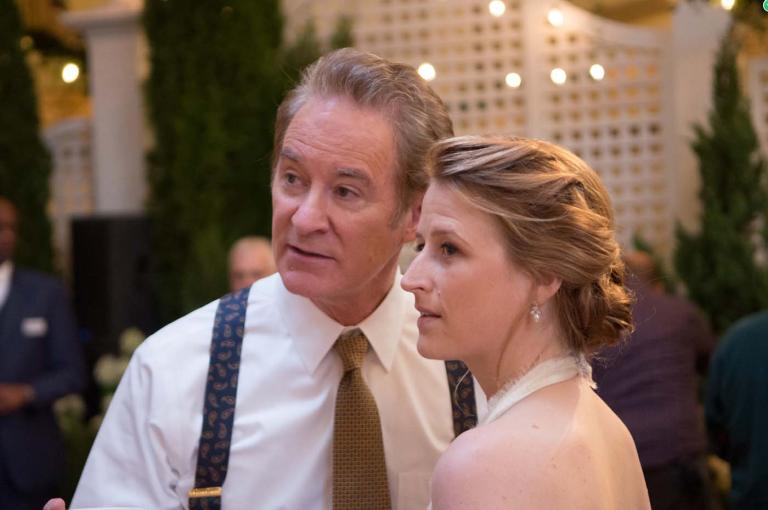
ricki 2That’s what Ricki tells Julie at Julie’s brother’s wedding. “Walk on,” she says, when it looks like Julie—overwhelmed, we assume, by memories of her own ruined marriage—is ready to bolt. And the thing that’s great about that moment? Ricki’s in a situation that she’d like to bolt from, too. She’s sitting in the back of her own son’s wedding, shunned and even laughed at by some of the guests. She feels totally unwanted, totally out of place. And yet, she’s there. She’s walking on—pushing through the shame and judgement and heartbreak of so many bad decisions. In that moment, she’s living in a nightmare built especially by her, for her. And she endures it all for the sake of her son.
People will say, and perhaps rightly, that Ricki and the Flash is overly sentimental, maybe manipulative. But for me the movie works, and this moment works beautifully. It’s a reminder of what love will, and should, endure. It shows us what real redemption—in the midst of real pain—looks like. And it depicts the sort of courage we rarely see in the movies—a courage that we might just have to find ourselves.

Tuesday, June 3, 2014

Maleficent: Broken Hearted


It's hard to watch good guys turn bad. We don't want our heroes to fall.

But sometimes, it can be hard to watch our villains turn good, too.

Take Maleficent, Disney's re-introduction of one of its all-time best/worst evildoers. In Sleeping Beauty, Maleficent is as bad as bad can be—the self-proclaimed "Mistress of all Evil" who calls upon the powers of hell to help her do her nasty work.

Let me be honest: I kinda like that in a villain. It's nice to see someone who knows who they are and really owns it, y'know? Forget the moral complexity, the makers of Sleeping Beauty said in 1959. Give us a woman with green skin and horns.

So much to my shame, I was ever-so-slightly disappointed in the positive moral trajectory in Maleficent. In the 2014 film, Angelina Jolie's Queen of Mean isn't so much as a dastardly diva as someone who's been really, really hurt—in more ways than one. The result, we see, is a pretty interesting examination of what hurt and bitterness can do to the human soul—and a hint of what is the only recourse out of it.

Be aware: There be spoilers ahead.

Maleficent wasn't always the towering figure of darkness we came to know in Sleeping Beauty. Once upon a time, she was a little fairy girl with horns and wings, full of hope and promise. When a boy named Stefan stumbles into her magical land and tries to swipe something (a pretty little gem), Maleficent gently tells him that stealing's wrong and winds up befriending the kid. The two become the best of buds (an unlikely relationship, given that Maleficent's magic land and Stefan's kingdom are constantly at war) and, eventually, even a bit more than that. In fact, Maleficent falls in love with the lad.

But the two grow apart and don't see each other for years. In that time, Maleficent becomes a powerful defender of her realm. Stefan becomes a steward for the mortal king. But when the dying king tells his court that he'll give the crown to whoever kills Maleficent, Stefan sees his chance for rapid career advancement. He takes off to the moors to rekindle his relationship with the fairy, planning to drug her and kill her while she sleeps.

But he can't: He still feels some affection for the girl (now a beautiful, winged woman). But he really covets the kingdom, too. So he slices off Maleficent's beautiful wings instead, taking them back to the king (misleading him in the process). Maleficent wakes up and is, understandably, devastated. Stefan mutilated the two things that made the fairy who she was: her wings and her soul.

Now, the potential spirituality of all this is interesting. When you look at a whole Malificent, your eyes are naturally drawn to the two things that make her so different from you and me—her wings and her horns. Both are, for Christians, instantly recognizable: When we think of humanoid-like beings with wings, most of us think of angels. Horns, on the other hand, are shorthand for the devil and demons. Neither horns nor wings are good or evil in themselves, of course, but they do represent—and have for centuries—the good and evil in the universe and, perhaps, the good and evil in ourselves (think about those angels and demons that appear on someone's shoulders in the old cartoons).

Stefan takes from Maleficent something angelic in her—something good. He steals what allowed her to fly closer to heaven. And, now earthbound—even dragging around at first as if the earth's gravity was pulling her closer to itself—she allows anger and bitterness and her more evil, horned nature to seep into the cracks of her soul.

She retreats to a dilapidated castle for a while to prood. And when she leaves it, Maleficent is a different person: Powerful in her anger, gorgeous in her hatred. She's a true villain in look and deed. She curses Stefan's little baby, Aurora. She and the king are now irrevocably at odds now, literally warring against each other. It reminds me of a really bitter divorce.

And that, I think, is at least partly intentional. We see here the horrors of a relationship gone horribly bad—how an act of betrayal can lead to an act of vengeance, a spiral of anger and hatred that can spin out of control. Each word and deed becomes more ammunition in this battle of … what? Wills? Control? Utter annihilation? Perhaps they don't know. When this sort of hatred spills over, there are no real goals, it would seem. Only the desire to hurt. We can get the same way, too. Many of us may know friends or couples who've fallen to this level—where they can no longer stand the sight of each other. In our hurt, we wall ourselves away. And when we emerge, we sometimes come out different: Our hate can make us strong (just like Darth Vader warned us), but it twists us, too. It turns us into something we weren't before and were never meant to be.

In Maleficent and Stefan, we see the corrupting power of hurt. The bitterness of loss. After Maleficent lays the curse on Aurora, Stefan turns into a full-time brooder, so obsessed with destroying Maleficent that he doesn’t even attend his own wife’s deathbed.

Maleficent is much the same … until she grows close to the very thing she cursed. Throughout Aurora’s childhood, Maleficent is never far away—watching, sometimes even caring for the child. So close she is that Aurora recognizes her shadow, a constant presence in her childhood. And she dubs Maleficent her fairy godmother. In the space of who knows how long, the two become close. And somewhere along the line, Maleficent realizes that she has room for something other than hate in her heart. Aurora—a name which references a strange dance of light in the cold, winter dark—has illuminated something of Maleficent’s black soul. Our villainess discovers a capacity for love.

I think that Disney missed a chance here to take this story of redemption and make it extra-special. Stefan could’ve been redeemed too, it seems: He wasn’t always bad. I’d like to think that he cared for Maleficent and loved his daughter. But here, Stefan takes the mantel of the true villain—incapable of accepting love through the iron hatred inside him.

But this, too, is a powerful reflection of how love, particularly God’s love, works. We may be offered love, even forgiveness. But we’re under no obligation to accept it. So often, we refuse. Our pain and anger won’t allow us to. We’d rather nurse a righteous bitterness than accept a little grace.

Toward the end of the movie, Aurora finds Maleficent’s wings and, magically still flapping, they find their way back to their mistress. She’s again whole, and powerful—a symbolic healing reflecting what Aurora had already done in the fairy’s soul. No longer the pure, horned evildoer, Maleficent spreads her wings, looking for all her past faults and sins, a little more angelic. She’s been restored. Redeemed. Maleficent, through grace, can fly again.