Showing posts with label movies. Show all posts

Sunday, August 16, 2015

Ricki and the Flash Shows Us What Courage Really Looks Like

There’s courage aplenty on the summer’s movie screens: Hey, there’s Ethan Hunt hopping on the side of a plane! Owen’s battling dinosaurs! Oooh, Scott Lang’s bravely shrinking for the sake of all humanity! Heroes are everywhere—risking their all for everything. And that’s great. Worthy, even.
But truth is, sometimes it’s easier to die for something than to live for it.
In Ricki and the Flash, the titular character (played by Meryl Streep) is an aging rocker, lost somewhere between a has-been
and never-was. She deserted her husband and kids to become a rock star. And even as she floundered, Ricki never looked back. She still plays music with her band, The Flash, in a small Tarzana, Calif., dive—checking groceries to pay the bills.
But when her daughter, Julie (Streep’s real-life daughter Mamie Gummer) tries to commit suicide, Ricki’s ex-husband, Pete (Kevin Kline) calls her home to Indianapolis. Once there, Ricki’s faced with a mountain of coulda-beens and shoulda-dones, confronting three children she hardly knows and who can barely stand the sight of her. “Guess you gotta give up a lot of special things to be a rock star,” Julie tells her.
Much of the movie is pretty discomforting—a litany of awkward dinners and embarrassing reunions, forced smiles and angry recriminations. And Ricki deserves everything she gets. She abandoned her family 20 years ago, and we can’t expect her kids to welcome her back as if nothing had happened. It’s not realistic. It’s not even fair. Not to her kids, anyway. Their mother made a really selfish, really bad decision that kinda crushed them. They have every right to be angry.
But here’s the thing: Ricki knows that. She didn’t come back for a joyous reunion. It’s not like she’s trying to kiss a 20-year-old boo-boo, making everything all better. She’s coming to help in the here and now—however her limited capital will allow her. She never really apologizes, but she accepts what she’s done. And she grieves.
When she confronts Julie’s ex—the catalyst to Julie’s attempted suicide—he lobs an emotional grenade. “Julie hates you,” he says.
“That may be,” Ricki says. “And I have to live with that every day of my life. But nowyou have to live with the pain you caused.”
Mistakes can be forgiven. Wounds heal. But the harm we do never just vanishes. We don’t get reset buttons.
We Christians talk a lot about forgiveness and redemption and all. It’s at the core of the faith, and one of the elements that makes it unique amongst all the world’s other great religions. But for those of us who have forgiven, and for those of us who’ve desperately needed forgiveness, the path to redemption and reconciliation isn’t always easy. Our religion doesn’t erase all the hurt, all the damage. Forgiveness isn’t just a matter of saying so. It’s a process—a long, hard slog for all involved, and with no pat promise of a happy ending. And there are times when Ricki wants to just … stop. To erase that chapter of her life completely. And she begins to wonder whether she’s worth loving at all. Take a look at this clip:

“It’s not their job to love you,” Ricki’s boyfriend Greg (Rick Springfield) says in the clip. “It’s your job to love them.”
It’s a great line. There are no exceptions to that, no conditions. “Hope bears all things, believe all things, hopes all things, endures all things,” Paul said. We love in the midst of pain, angst, discomfort. We love even when we want to run away.
It’s easy to tell someone we love that we’d die for them. It sounds very noble, very heroic, very Ethan Huntish. But as a friend of mine told me once, how many people get a chance to really make good on that promise? Not many. For most of us, the real trick is to live and love when we’re not loved back. Live and love in a painful situation. To face up to the consequences when we’ve done wrong. To walk on.
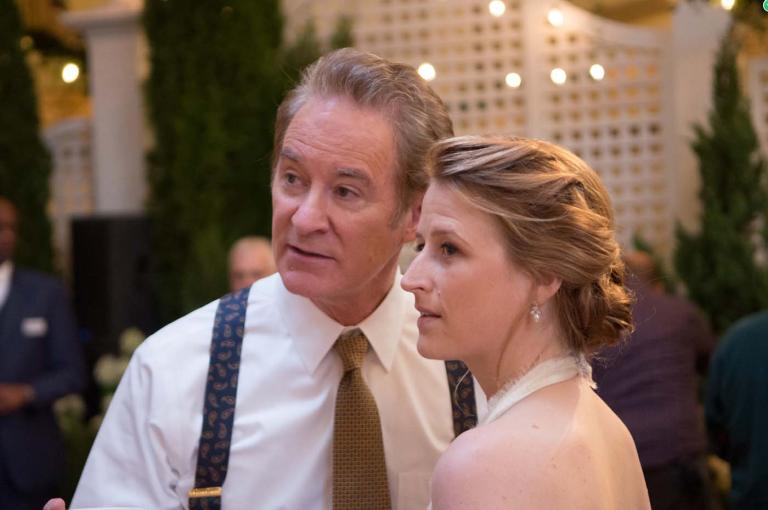
ricki 2That’s what Ricki tells Julie at Julie’s brother’s wedding. “Walk on,” she says, when it looks like Julie—overwhelmed, we assume, by memories of her own ruined marriage—is ready to bolt. And the thing that’s great about that moment? Ricki’s in a situation that she’d like to bolt from, too. She’s sitting in the back of her own son’s wedding, shunned and even laughed at by some of the guests. She feels totally unwanted, totally out of place. And yet, she’s there. She’s walking on—pushing through the shame and judgement and heartbreak of so many bad decisions. In that moment, she’s living in a nightmare built especially by her, for her. And she endures it all for the sake of her son.
People will say, and perhaps rightly, that Ricki and the Flash is overly sentimental, maybe manipulative. But for me the movie works, and this moment works beautifully. It’s a reminder of what love will, and should, endure. It shows us what real redemption—in the midst of real pain—looks like. And it depicts the sort of courage we rarely see in the movies—a courage that we might just have to find ourselves.

Friday, September 5, 2014

Forrest Gump: He Knows What Love Is

“Stupid is as stupid does.”

That’s Forrest Gump’s snappiest comeback line. Whenever someone asks Forrest if he’s an idiot (which is often), he remembers what his Mamma always told him: Stupid is as stupid does. It’s not a denial. It’s simply a statement of fact, and a bit of a challenge. Don’t judge me by how I think. Judge me by what I do. Oh, and while you’re at it, judge yourself, too.

Forrest Gump, originally released in 1994 and the winner of six Academy Awards (including Best Director Robert Zemeckis, Best Actor Tom Hanks and Best Picture) is returning to theaters today, rolling out on 300 IMAX screens across the country. I’ll be interested to see whether anyone cares.

Forrest Gump hasn’t aged well for some. When you think of the year’s classic movies, you maybe think of Pulp Fiction, The Shawshank Redemption or The Lion King before this Oscar winner. Forrest Gump can feel a little too milquetoast by comparison. The special effects—cutting edge for the day—feel pretty dated now. Lines like “Run, Forrest, run!” and “life is a box of chocolates” are more likely to trigger eye rolls than smiles. Some positively hate the thing. Writes Amy Nicholson of L.A. Weekly:

“Forrest Gump has persevered, still celebrating 20 years of ignoring the tragedies that lurk beneath our lives like great whites in the dark waters below his shrimping boat. Let us not forget that the Bubba Gump fortunes only came after a hurricane took out all of Forrest's competition. Post-Katrina and post-recession, even his seafood riches now have a rotten aftertaste.”

But like folks who met Forrest in the movie, Amy underestimates the guy. Forrest might not have been fully aware of hurricanes or understood the Vietnam War, but he’s no stranger to tragedy. He understands pain maybe better than most of us. He loses his mother. He loses his best friend. He loses—repeatedly—the love of his life. And he’s never allowed to forget how slow he is. When Forrest learns he fathered a child, he’s amazed, then terrified that his son might be slow, too.

And yet, rather than grow angry or bitter or fatalistic, Forrest grieved and moved on. His journey is one of deep, abiding faith.

Forrest Gump is a deeply spiritual movie, one of the most faith-driven stories I’ve ever seen. Echoes of scripture weave through each storyline. It’s most obvious, maybe, in his relationship with Lieutenant Dan (I talk about it a little in the spiritual content section of my Plugged In review), but nowhere is it more poignant and powerful than in his love for Jenny, his wayward “girl.”

Jenny is a troubled woman. Like the song says, she searches for love in all the wrong places—trying to find happiness in parked cars or drug-filled penthouses. She poses for Playboy. She sings folk songs naked in a strip club. She longs for love, but instead she finds a string of abusive boyfriends, made (it’s suggested) in the image of her father.

When she was a kid being chased by her dad, she asked Forrest to pray with her:--begging that God would turn her into a bird so that she could fly away from her horrid life. She never loses her desire for wings, it seems: She climbs bridges and balconies, longing to wing her way into oblivion.

And yet she does fly. Again and again, she flies from her past, remaking herself at every stoplight—as if she could somehow fly away from herself. And in so doing, she flies away from Forrest, too.

“Can I have a ride?” she asks a passing truck driver after Forrest “rescues” her from the strip club.

“Where are you going?” he asks.

“I don’t care,” Jenny says.

I don’t know if I’ve ever seen a better depiction of how our own sin and shame impact our relationship with God.

See, Forrest loves Jenny—loves her unconditionally, just as God loves us. He loves with a perfect, undying passion. And Jenny loves Forrest, too … sorta. But she seeks fulfillment elsewhere time after time. And when Forrest asks Jenny to marry him, she realizes that he’s too good for her.

“You don’t want to marry me,” she says, sadly.

 “Why don’t you love me, Jenny?” he asks. “I’m not a smart man, but I know what love is.”

Jenny, after all this time, sees that it’s true. He knows what love is. It’s she that doesn’t.

Now, I’m not calling Forrest a Christ metaphor. Jesus and Forrest are pretty different … except in that image of love. A love that’s undimmed by what we say or do, a love unstained by our own sin and shame. A love that would die for us, and has.

That kind of love can seem a little stupid and simple-minded to our jaded eyes. Naïve. Oblivious. Like Forrest himself. Like, Amy Nicholson tells us, the movie is.  

And yet there’s unfathomable beauty there, too. A love we can’t understand, but part of us wants to.

“Stupid is as stupid does,” Forrest says. The Apostle Paul said something similar in his first letter to the Corinthians.

“For the foolishness of God is wiser than human wisdom, and the weakness of God is stronger than human strength.”

In Forrest Gump, we’re given a fool—one whose foolish ideas of love can put our own wisdom to shame.


Tuesday, August 5, 2014

Guardians of the Galaxy: Bad Childhoods


Life isn’t always kind. It’s not always fair. From time to time, most of us probably feel like we’ve gotten a raw deal, though some of our deals are rawer than others. Some of my closest friends have struggled with all manner of challenges: Physical disability, rocky family life, just plain bad luck. And yet, they’ve overcome and succeeded in spite of them.

They’re a little like Guardians of the Galaxy in that way.

At Plugged In's blog, I talked a little bit about how our five Guardians in Marvel’s newest megahit kinda remind me of Paul’s famous body parts passage in 2 Corinthians 12, which goes in part like this:

The eye cannot say to the hand, “I have no need of you,” nor again the head to the feet, “I have no need of you.” On the contrary, the parts of the body that seem to be weaker are indispensable, and on those parts of the body that we think less honorable we bestow the greater honor, and our unpresentable parts are treated with greater modesty, which our more presentable parts do not require. But God has so composed the body, giving greater honor to the part that lacked it, that there may be no division in the body, but that the members may have the same care for one another. If one member suffers, all suffer together; if one member is honored, all rejoice together.

 And so it is with the Guardians. But there’s more to them than that. They don’t just overcome their own selfish natures to become stronger as a team. They overcome their own hard knocks to inch closer to what, I’d argue, God might’ve had in mind for them all along (if, y’know, they actually existed).

Think about these heroes for the moment. Peter Quill had his mother taken from him and was kidnapped by space pirates in the span of 12 hours. That’s not what I’d call a great familial foundation for a hero. Gamora had it worse: She was adopted by one of the worst people in the entire galaxy—the game guy who killed her original family—and trained to be a fearsome assassin. It’s like Hitler plucking a girl from  and turning her into a ninja. Drax watched his whole family die. Rocket the Raccoon is understandably bitter at being the product of a weird genetic experiment. And Groot—well, I don’t know about Groot. Perhaps he had a good home life. But that would explain why he’s so comparatively well-adjusted.

These Guardians didn’t have anything in their backgrounds that would scream “future hero” to you. And yet, they became heroes anyway. This isn’t a Lord of the Rings-like story, where a handful of ordinary hobbits saved the world. This is the story of a handful of extraordinarily scarred, damaged people (or trees or raccoons)  that saved a world. No excuses, no pity parties (well, not many). They just saw what needed to be done and did it.

I’ve talked before, and I’ll talk again, about how God can use our weaknesses for His own nifty purposes. But He can work through and past our pain, too, if we let him. If we look at the Bible, we see that theme at work pretty regularly.

Jacob was tricked out of the wife he wanted. Joseph’s own home life was pretty horrible—or at least it was when his brothers sold him into slavery. Moses, a bigwig in Egypt, had to say goodbye to his home and family and life of luxury when he accidentally killed somebody. David was forced to run away from the palace, too. They were all cast out—just as these Marvel vagabonds were. And yet, God had some pretty amazing plans in store for each of them.

There are some preachers who teach that, if we have faith in God, we’ll be safeguarded from sorrow. And there are lots of ordinary believers who seem to believe that God is like a magic shield. I’m guilty of that sometimes. I’ve been very blessed, and when I hit a season of life that seems … well, less-than-blessed … I find myself wondering if there’s been some sort of cosmic mistake. Did I forget to fill out some sort of good-person form or something? Did I land on the naughty list accidentally? What’s with this crud?

The Bible reminds us that God-as-good-luck-charm isn’t really good theology. Yes, the Bible talks about blessings and rewards, too, but we’re explicitly told we will have trouble. We’re shown that we have to persevere and work through difficulty. We can’t give up when life tosses us a couple of curveballs. God still has plans for us. Big plans.

Guardians of the Galaxy shows that concept at work. I see echoes of Jacob and Joseph and Moses in this quirky little adventure. And that even if we’ve been saddled with a whole bushel of lemons in our lives, we can take those lemons and turn them into really eco-friendly air fresheners. Or something.

Friday, July 4, 2014

A Few Films for the Forth

To commemorate Independence Day for Plugged In, I talked a little about how important movies have been to the American story. They’re about as American as you can get, really: The United States was a big player in its invention and development, and now they pretty much dominate if not the art of movie-making, at least the business. Right alongside food and technology, movies are one of our biggest exports. So it’s a big deal.

I suggested that, if you wanted to do something quintessentially American today, you could do worse than watch a movie.

But what movie?

Well, let me make a few suggestions and give you an old movie from each decade in the 20th century, between 1930 and 2000—a movie that, while perhaps lacking literal fireworks, say something about who we Americans are, who we’d like to be and why we kinda make a big deal about every July 4. Not all these movies are family-friendly, by the way ... some are pretty harsh. but I still think they're worth seeing.

Stagecoach (1939): Doesn’t seem you could go wrong picking a Fourth of July movie from 1939, what with Gone With the Wind and Mr. Smith Goes to Washington released the same year. But if you’re going to talk about quintessentially American movies, you gotta stick a John Wayne flick in there, and his performance here as Ringo Kid made the tough-talking cowboy a star. The flick is about a stagecoach rumbling through Apache territory and carrying a cadre of wildly divergent passengers (sort of like MTV’s The Real World under Indian attack) and is considered one of the best Westerns ever.

Casablanca (1942): Given that the United States was fighting World War II for nearly half of the decade, no surprise that patriotic movies would’ve been in their heyday here. 1942’s Yankee Doodle Dandy, a biographical musical starring James Cagney, has rightly  landed on other patriotic lists, as has 1946’s The Best Years of Our Lives—the bittersweet story of American G.I.’s coming home. But for me, you can’t beat the sappy but incredibly effective story of Rick and Ilsa, caught up in a world where their problems don’t amount to a hill of beans.

High Noon (1952): Another Western, this one stars Gary Cooper as a marshal facing certain death as he gets set to square off against a slew of criminals determined to kill him. My kids couldn’t stand the song that constantly nattered away in the background (“Do Not Forsake Me, Oh My Darlin’”), but besides that, this is almost the perfect Western. When I think about what a true hero looks like, I think of Gary Cooper’s Will Kane.

To Kill a Mockingbird (1962): Or maybe a true American hero looks more like attorney Atticus Finch.  Played by Gregory Peck (who won an Academy Award for his work here), Finch really does believe that all men are created equal—something that runs counter to the thinking of most of his neighbors in the fictional town of Maycomb, Alabama in the 1930s. When he’s asked to defend an African-American who’s been unjustly accused of raping a white teen, he takes the case and defends the man eloquently—only to have the verdict snatched away by circumstance. This is a beautiful, poignant story that lauds America’s ideals while acknowledging how far we fall short of them at times.

All the President’s Men (1976): Speaking of ideals gone awry, this movie delves into Watergate—specifically the two journalists who broke the story wide open. With reporters Bob Woodward and Carl Bernstein played by two of America’s coolest actors, Robert Redford and Dustin Hoffman, respectively, All the President’s Men is a riveting piece of cinema. And if you don’t think that the exposure of a massive political scandal feels particularly patriotic … well, I, as a journalist, would disagree. There’s nothing more American than the Fourth Estate doing its job.

Raiders of the Lost Ark (1981): Harrison Ford in his fedora and carrying his bullwhip? Dude, movie heroes don’t feel more American than that. A callback to the days of the Saturday afternoon serial, Raiders is pure movie magic, from the minute that boulder starts rolling to when people’s faces start to melt.


Saving Private Ryan (1998): Ranking as one of the best war movies ever, Saving Private Ryan tells the story of Captain John Miller and a squad of soldiers who are tasked with finding Private James Francis Ryan so he can go back home. The movie is full of heroism and heartache, with soldiers making tremendous sacrifices along the way. In the end, the dying captain tells Ryan, “James … earn this. Earn it.” It’s a great reminder of how precious life, and by extension freedom, are. How much has been sacrificed for it. And we should never take it for granted.

Wednesday, May 14, 2014

Growing Up Godzilla

Godzilla will stomp into theaters this weekend, doing his part to tear down lots of cities and rake in lots of money. I've seen it, and later you can check out my review at Plugged In come Friday and some extra thoughts right here that very same day. But in advance of the big day, let me tell you about my very first Godzilla movie.

I was a Godzilla fan before I ever saw one of his movies. Our school library had a series of books about classic movie monsters, and when I was around 9 or 10, I checked out the book on Godzilla about 17 times. I knew all the characters: Rodan, Mothra, Ghidorah, the works. Their city-stomping ways fascinated me, and I wonder if maybe these Japanese Kaiju have always held a special charm for kids (as frightening as they’re supposed to be). They're big. They're bad. They can destroy whole cities like we might tear down a stack of blocks. Such overwhelming power. Such mighty feats of strength. For kids who don't have much of either, Godzilla and company would be pretty attractive. No one would ever send Ghidorah to bed early. Godzilla would never get bullied on the playground.

No wonder Godzilla—Japan's ultimate scaly villain in 1954—morphed into a hero after a movie or two. Kids needed the big guy in their corner.

When I was in fourth grade, we heard that Godzilla vs. Monster Zero was coming to a local, late-night horror-movie showcase called Shock Theater. The movie wouldn't start 'til 10:30 and probably end after midnight, but all my friends with permissive parents said they'd be watching. And so I asked—no, begged—my parents if, just this once, I could stay up and watch it, too.

In a complete departure from the parenting principles I'd grown up with, they said yes.

It was a stunner, and I felt curiously grown up. Never mind that my dad was going to watch it with me, or that a couple of my stuffed animals were on call, too—just in case I got scared. The fact that I was going to stay up past midnight—watching Shock Theater, no less—was a big marker on my way to adulthood. Today, late-night television. Tomorrow, the driver's license.

It proved to be a terrifying night.

It wasn't the movie: Monster Zero, I think, was kinda lame for a kid looking for some Shock Theater-like thrills. But somewhere after Monster Zero (Ghidorah) destroyed one city but before he destroyed this other city, my dad went to bed. Went. To. Bed. Never had I been shouldered with such hefty responsibility, to be awake and safeguard the house alone before. It was, again, a strangely thrilling moment … and absolutely horrible, too. When he said goodnight and left me alone in our gloomy basement family room, I felt like I was being treated like an adult, and I knew I was nowhere up to the challenge.
I watched the movie to the credits, walked to the television and turned it off. The house was as still as a tomb. I flipped off the lights to the family room and watched it go black. I inched up the hallway stairs, straining my ears for the sound of any strange skittering sounds or raspy breathing, then turned off that light, too. My heart was pounding. I was clutching my stuffed bear 'til the stuffing nearly oozed out his ears. But room by room, I turned off the lights—turning some on along the way so I'd never be in total darkness—until I reached the safety of my bedroom.
It was the first time I realized what an empty, dark house really looked like. Felt like. Before, my parents were always on patrol as I softly fell asleep. Tonight, I was on my own.
I felt like an adult, and it was horrifying. I was not strong or powerful like a movie monster, ready to deal with invaders from Planet X. I was scared. It was like I had a premonition of adulthood. Someday, I'll need to turn off the lights by myself all the time, I thought. What an awful thought
I suppose I should say something spiritual here. Maybe how we're all children of God and we can just relax, 'cause he'll watch over us in our metaphorical dark houses. He’s always on patrol. And I think that's true. But sometimes, God's presence can be a difficult thing to feel. Sometimes we can feel very alone in a dark and too-quiet world. We feel the pressures around us. The fear pressing in on us. Out from us.
When we're children, I think there's a time when we imagine that adults don't get scared. If only that were true.
But we deal, I guess. We have to. And I think with God's help, we learn how to cope. We're a little like the folks in Godzilla movies, maybe. The ones who aren’t screaming. We're surrounded by forces and fears we can't control and barely comprehend. But we move forward—with fear, yes, but with hope. Hope that becomes a wary confidence. Even courage. And maybe that hope is something that God gives us. Maybe our worlds will look pretty bad at times, like something big and fire-breathing trashed it all. Maybe we'll see some serious destruction when the sun comes up. But the sun does come up. And with each new day we're given another chance to help put things right.
I don't know whether I can blame Monster Zero for this, but when I was in junior high, I noticed something interesting in my sleep patterns. If I was spending the night at a friends' house or at summer camp or something, I could never go to sleep until I was sure that everyone else was. I wanted—needed, really—to be the last guy awake. And I'm still that way. I won't ever go to sleep if there's someone in the house is stirring still—watching a movie or reading a book. It's physically impossible for me to do so.

I'm the adult now. And maybe that night with Godzilla and Monster Zero taught me that, as an adult, I need to be vigilant—the guy on patrol--because no one else is going to do it for me. I'm the one who turns out the lights.