Showing posts with label The 33. Show all posts

Sunday, November 29, 2015

We Need to See More Movies Like ‘The 33′

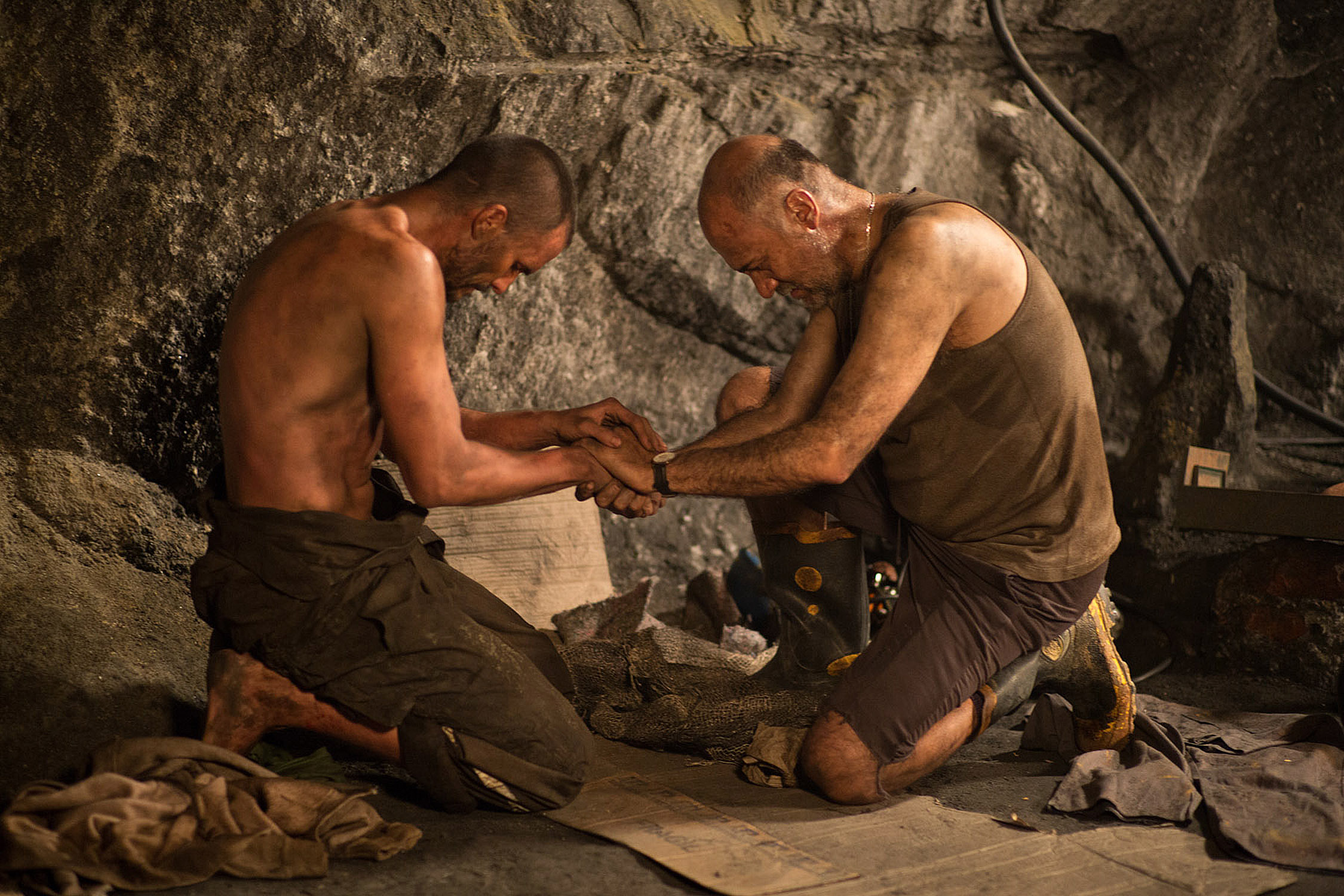
33 praying
Marco TreviƱo and Juan Pablo Raba from ‘The 33,’ photo courtesy Warner Bros.
Reprinted from my Watching God blog on Patheos.
Theaters are full of secular movies where God’s name is mainly used as a curse. A few make room for some Christian movies, too—cinematic sermons made specifically to bolster belief (sometimes at the expense of the actual movie).
There’s not a lot of room left, it seems, for movies that show the sort of faith that looks familiar to most of us—a faith that’s not particularly showy or splashy or supernatural, but one that nevertheless is with us every day, even in the most horrific moments in our lives. Maybe especially in those moments.
The 33 introduces us to group of miners trapped nearly a half-mile beneath the earth’s surface. Their situation is incredibly dire: Mining is a dangerous business, and rescues are as rare as accidents are common. Early on, it feels like the mining company’s already given the trapped men up for dead. “Nobody’s going to hear us!” foreman Don Lucho (Lou Diamond Phillips) says. “Nobody’s going to help us!”
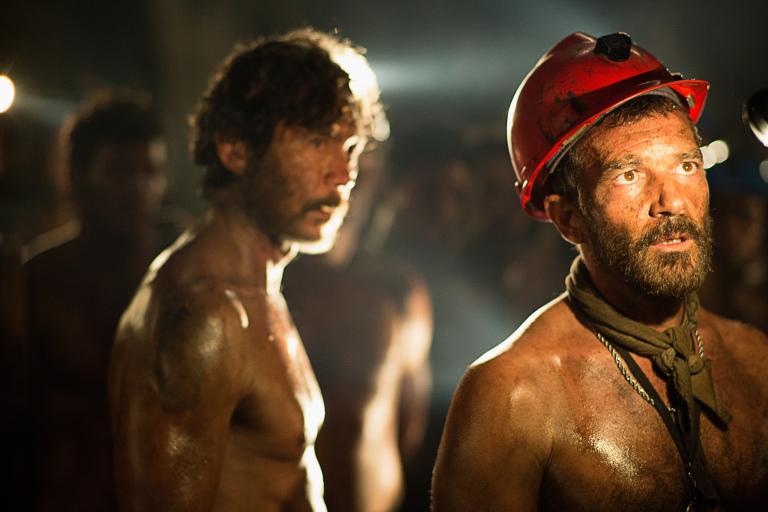
33 2
Lou Diamond Phillips and Antonio Banderas in ‘The 33,’ photo courtesy Warner Bros.
In a fictional movie, that’d be the cue for some serious special effects. Director Michael Bay would save the miners through some spectacular explosions. Eli Roth would surely have the miners kill and eat each other. A Christian filmmaker might give the miners a mysterious tunnel to the top and, if he’s feeling particularly devout, maybe a few angels to dig it.
But The 33 is based on a true story, and this story does not allow for cannibalism or supernatural miracles. Director Patricia Riggen and the other filmmakers needed to follow, more or less, the facts. And the fact is, many of them did what many of us would do if trapped under a literal mountain: pray.
Faith isn’t the prime theme of The 33, but it undergirds much of the movie. Catholic iconography is found everywhere, it seems—totally fitting within this predominantly Catholic country. When a miner leader named Mario (Antonio Banderas) divvies up the final bits of their food, the meal takes on a Last Supper-like quality: One of the miners even envisions Mary and Jesus stopping by.
During that meal, a miner named Dario (Juan Pablo Raba) offers up a handful of cookie crumbs for the miners to share. It’s a deeply significant gesture, given that two weeks earlier, Dario ransacked the food stores and stuffed handfuls of cookies into his face. Of all the miners there in the dark, he’s the only one who felt truly lost—a selfish alcoholic with no direction or purpose.
In my Plugged In review, I draw some parallels between the mine and our concept of a hot, dark, hell—and no one feels that hell as sharply as Dario. Indeed, the mine becomes a place of torment for him, wracked by alcohol withdrawal and anguished regret.
But a miner known mainly as “the Pastor” befriends Dario and, in the midst of Dario’s torture, comes alongside him and comforts him. “We can say a prayer together, if you like,” he offers.
“I don’t know the words,” Dario says.
“God doesn’t care.”
We’ve seen sinner’s prayers in many a Christian movie, and sometimes they can feel forced and hokey. But in this context, it feels natural. It feels right.
“Lord, to whom shall we go?” Peter asked Jesus when many other disciples were turning their backs on Christ. And there, in that pit, Dario’s turn to God bears a hint of Peter’s desperation. Like Peter, there was nowhere else for Dario to turn in that darkness. Like Peter, there were just two choices left to him: A life (whatever the rest of that life might look like) of hope and redemption, or of a turn to death. When you can’t save yourself, you must look for a savior.
THE 33
From ‘The 33,’ photo courtesy Warner Bros.
All the miners are, more or less, in a similar spot, relying on someone else to save them. They cannot escape the mine on their own. They must wait and hope and trust. They must have, in a very real sense, faith. And faith is a choice.
“I believe we’re going to make it out of here because I choose to believe it!” Mario thunders. “All 33 of us!” He chooses to believe in spite of the odds. In spite of the countless tons of earth above their heads. And faith is an incredibly powerful thing.
Mario and the miners weren’t waiting for a supernatural miracle—for that huge rock that blocked their way to magically vanish. But I believe their faith—in their ability to endure, the people topside and, yes, their faith in God—helped them to survive.
After 69 days, their faith was rewarded. Every one of those miners returned to the world of the living after more than two months in darkness. Before taking the strange elevator out of the mine, Mario scrawls on a wall, “God was with us.”
Faith doesn’t always move mountains. Sometimes, it’s enough for it to shed a little light inside them.

Sunday, September 20, 2015

The Season of the Sorta-Secular Christian Movie

Originally published at my Watching God blog at Patheos.org.
Last year was called the year of the faith-based movie, and in a lot of ways, it was. Three straight-up Christian flicks (Heaven is for Real, God’s Not Dead and Son of God) each made more than $50 million. Another two movies theoretically made with a faith-based audience in mind—Noah and Exodus: Gods and Kings—banked even more. Only problem: Secular audiences had no use for the former, and most evangelical Christians kinda hated the latter.
This fall, though, we’re about to see a different sort of faith-based movie in theaters. And it’ll be an interesting gauge whether Christians can get excited about “Christian” movies that don’t feel like Christian movies.
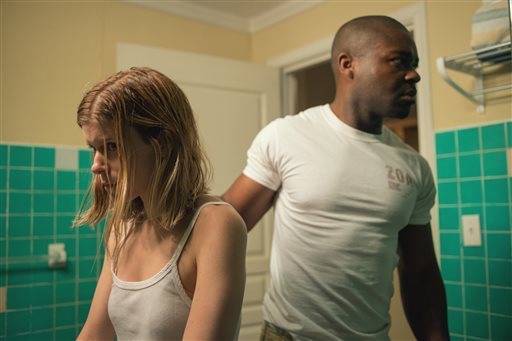
captive
Kate Mara and David Oyelowo in Captive
Up first: Captive, released this very day. The movie’s stars, David Oyelowo (who was robbed of an Oscar nom in Selma), and House of Cards’ Kate Mara, aren’t the sort you’d expect to show up in a Christian movie—but then again, this doesn’t feel like your typical Christian movie, either.  It’s a rough, story dealing with messy subjects and involving not a small amount of tension. Yet Captive is unquestionably a Christian story—so ridiculously Christian, in fact, that most faith-based filmmakers would’ve rejected it out of hand for being way too improbable had it not been absolutely true.
In 2005, Brian Nichols (Oyelowo)—on trial for rape—escaped from an Atlanta courthouse, killing four people en route to the apartment of Ashley Smith (Mara). He held Smith hostage for seven hours, and no one would’ve been surprised had he killed her, too. But during their time together, Smith read portions of Rick Warren’s Christian bestseller The Purpose Driven Live, and he eventually let her go.
Oyelowo is an outspoken Christian. But he had no desire to make a typical Christian movie.
“Yes I’m a Christian myself, but I’m not particularly interested in quote-unquote preaching to the choir,” Oyelowo told the Los Angeles Times. “I am a big believer in the potency of artistic endeavor at its highest. To proselyte through your storytelling is not good storytelling.”
And then there’s The 33, to be released Nov. 13. It’s another true story, this one focused on the Chilean miners who were trapped in a mine for a staggering 69 days before they were finally—some would say miraculously—rescued.
It’s technically a secular movie, this one from Warner Brothers. Starring Antonio Banderas, Lou Diamond Phillips and Academy Award-winner Juliette Binoche, The 33has the pedigree of a solid independent film. But it doesn’t shy away from the deep faith of many of the miners (it even features a wayward miner finding salvation) or the fact that many saw divine providence in the rescue.
the-33
Antonio Banderas in The 33
“We realized we had only one alternative, and that was God Himself,” said miner Jose Henriquez, known by his fellow miners as “the pastor,” said at the 2011 National Prayer Breakfast in Washington D.C.
For a movie-lover like me, this is a pretty encouraging trend. While traditional Christian movies are getting better (and, obviously, some have even found financial success), most  are still not flicks you’d invite your agnostic friends to without blushing a bit.  And when secular studios try to woo Christians with big-budget epics and powerhouse directors (Darren Aronofsky directed Noah, and Ridley Scott helmed Exodus), they often show a certain tin ear when it comes to what most evangelical Christians actually want to see.
The fact that it’s a little hard to classify both of these movies as straight-up “Christian” or flat-out “secular” is encouraging, too. Captive is a Christian movie that honors the art. The 33 is a secular movie that honors the story’s intrinsic spiritual backbone. These fall movies not only take faith seriously, but they’re seriously watchable, too.
But will anyone watch them? These are smaller movies, after all—not superhero-laden blockbusters guaranteed to make 16 bazillion dollars. And while faith-centric moviegoers have shown a willingness to go to theaters if they have something to see, they can be a pretty persnickety bunch. And neither movie is as squeaky clean as some Christians demand.
“[Captive is] a little bit messy,” admits Captive co-producer Terry Botwick to the LA Times. “But that’s where the truth of it is.”
And that, I think, is often where the truth is often found: In the mess. Christianity was founded on a messy execution, after all. The world in which Jesus walked was hardly pristine. As Christians, I don’t believe that we’re supposed to ignore the grit and grime of the world, but rather see it clearly and do something about it.
Christian movies shouldn’t be needlessly gratuitous. But I’d argue they don’t need to be ruthlessly sanitized, either. There will always be space in Christian cinema circles for strong, clean, inspiring Christian stories. But I’m hoping there’s a future for unapologetic faith-based movies with a little grit, too.