Sunday, March 13, 2016

The Problem with R-Rated Superheroes

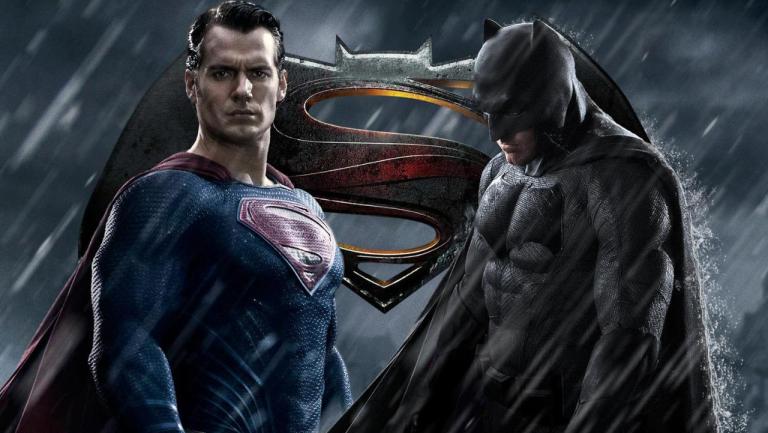
batmanvsuperman-xlarge
Artwork from Batman v Superman: Dawn of Justice, courtesy Warner Brothers
Batman v. Superman: Dawn of Justice will be rolling out to theaters later this month. But before the movie even lands in the local cineplex, there’s already buzz about what’ll be on the home video release: A big letter R.
According to ew.com, the “Ultimate Edition” of the movie will bear an R rating when it rolls out on DVD and Blu-Ray. Wolverine 3, due about this time next year, will also be shooting for an R. Many speculate that this could just be the beginning of a new wave of R-rated superhero stories. So prevalent is this sudden push for restricted ratings that Ant-Man director Peyton Reed suggested cheekily that this could be only the beginning. “Breaking: ANT-MAN AND THE WASP is going FULL NC-17,” he tweeted.
Some superhero fans, primed by the runaway success of the R-rated Deadpool, are excited to see superheroes go in a harsher, grittier, bloodier direction.
Don’t count me among them.
Don’t misunderstand me. I’m all for a bit of grit in my superhero stories. I wrote a book on the spirituality of Batman, based largely on Christopher Nolan’s darkly terrific Dark Knight trilogy. I’m eagerly awaiting the premiere of Daredevil’s second season on Netflix—a show that walks the line between PG-13 and R. Even Captain America—as straight-laced a superhero as there is—seems to have gotten deeper as his movies have gotten darker.
But when moviemakers push these superheroes into ever more depressing landscapes, I think we risk losing what made them so super to begin with.
Every culture has its myths and legends, be they religious or secular, featuring brave and powerful heroes and heroines who fight for what that culture holds dear. Often these stories had a hint of history in them, but whether they were historical or not was really, in a sense, beside the point. These stories linked generations together and helped give shape to society. And as such, they were often designed to teach younger listeners something about the world and how they should behave within it.
Granted, the characters in these stories were often far from perfect—indeed, they often behaved quite imperfectly—there’s still an aspirational flavor to them. The Greeks had their Iliad and Odyssey and their pantheon of heroes. The English had King Arthur and his knights. And for more than 80 years now, America has had its superheroes.
Like many of their mythic predecessors, our superheroes are often demigods, graced with powers and skills unattainable to folks like us. And they, like Achilles and Lancelot, have their share of flaws.
And from the moment of their inception, they were made for kids. Back in the 1930s and ‘40s, comics weren’t the province of fortysomething guys wanting to add to their collection. Children bought them, saving their nickels to take home Superman’s latest adventures, or reading about the Fantastic Four in the corner drugstore.
Sure, I understand that comics don’t fit that mold anymore. According to a survey by DC (the folks behind Superman and Batman), 64 percent of comic-book buyers are between the ages of 35 and 64. Deadpool, who first appeared in 1991, was never a kiddie comic-book character. And as I’ve mentioned, there’s an upside with even traditional superheroes growing grittier and more complex.
But you don’t adult content to tell a mature story. You can add grit without adding dirt, and excellence does not require f-words.
And while comic books might be the providence of adults these days, the superheroes themselves—the Supermans, Batmans, even, I’d wager, the Wolverines—are still very much embraced by children.
Take a spin through the big box store, and you’ll find legions of superheroes stocking the shelves where kids tend to gather. X-Men action figures. Iron Man birthday streamers. Captain America lunchboxes. LEGO became the biggest toy company in the world, in part, by peddling superhero sets to legions of children and tweens.
Even now, when we talk about the influence of superheroes on the culture, we understand the innate moral authority that these (admittedly flawed) characters bring to the table. They teach us lessons (“With great power comes great responsibility,” Spider-Man tells us). They serve as symbols (For years, superhero fans thought it was a crime that Wonder Woman had been so spurned by Hollywood: Girls, they said, needed to see a female superhero on screen.) At their best, they serve as role models. Even Batman, the poster boy for flawed superherodom, suggests that there’s light and hope that can be found even in a dark, dark world. That’s a message that all of us could stand to hear.
Heroes, even in today’s culture, mean something—especially to children. And it seems that, when we make their worlds too dark or make the heroes too adult, We lose their ability to reach the audience that arguably needs them the most. And we’re not doing just a disservice to kids. We’re doing a disservice to the superheroes themselves.

Sunday, January 31, 2016

X-Files: Signs of Promise

Much has been written about the greatness of The X-Files—how the original series revolutionized television, laying the foundation on which much of today’s prestige TV is built. It was, also, a deeply spiritual show—probing belief, faith and the supernatural in ways really unheard of on television at the time. And when Fox announced that it was going to bring Mulder and Scully back to the small screen for a six-episode season, I was pretty excited.
I was underwhelmed with the first episode of the new six-episode season, “My Struggle:” So much to set up, so little time. But “The Founder’s Mutation”—though far more graphic—hinted that Fox’s new iteration of this legendary show may have some fangs yet. Indeed, it may even be more ambitious than the first.
The new world in which Mulder and Scully inhabit is an even more difficult to have faith in much of anything. “I only want to believe,” Mulder says in the opening episode. “Real proof has been strangely hard to come by.” Forget probe-happy aliens or contortionist monsters: So far, the show’s big bogeymen have been all-too human. And so far, it seems, their evil is rooted (as it often historically is in the show) in a certain desire to play God.
Dr. Augustus Goldman in “The Founder’s Mutation” is just such a man. In the episode’s opening minutes, he seems to be akin to an aloof cult leader, or perhaps even a distant god. He’s called “the Founder” in near reverential terms, and he seems to speak through a proxy—a prophet, if you will, in a suit and tie—informing the Founder’s underlings that he (the Founder) is displeased with their work. But that’s all the Founder’s spokesman will volunteer right now, leaving the minions frustrated and confused.
“We need more than just pronouncements from above,” one exclaims. “We need direction!”
But gods don’t work that way. It’s only when one of the scientists working for him, hearing voices inside his head, kills himself (with a highly disturbing letter opener to the ear) that Goldman is at all touched by the world he helped create. And even though the scientist is well insulated, Scully and Mulder eventually find a way to talk with the guy through a bit of intercession—provided by, perhaps significantly, the Catholic Church. Or, more specifically, by Our Lady of Sorrows Hospital at which Scully has worked a number of years.
Now, a quick step back to the episode’s title—”The Founder’s Mutation.” A founder mutation is a critical component of evolution, according to Mulder. Evolutionary theory is based on the idea that life is a product of such mutations. Most are discarded by nature. But a few beneficial ones hang on and are passed to a new generation, and it’s that process that pushes evolution along. The doomed researcher wrote the phrase on his hand right before he killed himself, and it’s interesting that throughout the episode, we see pop-culture allusions to our own mutative development: An old Planet of the Apes movie plays in the background at a hospital. Mulder watches the opening scenes from 2001: A Space Odyssey, where early, hairy proto-people discover the black monolith (tellingly mispronounced as “mono-myth” by his … son. More on that later).
But the episode’s name may have a deeper meaning. I’ll just let Entertainment Weekly’s great Jeff Jensen explain further:
“Founder’s Mutation” doesn’t just evoke evolution, but the concept that humanity, corrupted by sin, represents a deviation God’s original design. It turned out that Dr. Goldman was one of Our Sorrows’ biggest donors; he was underwriting the maternity ward. In return, Our Lady fed him patients/test subjects for his work — specifically, children born with genetic abnormalities. Sister Mary characterized the pregnant women in their care as “unfortunate or damaged” as a result of drugs, alcohol, or bad choices with bad men. “Desire is the devil’s pitchfork,” she said. And later: “But as long as there is an innocent child involved, we’ll provide for each and every one [of these women.]” In an episode in which several of the characters Mulder and Scully encountered were basically some coarse, corrupt, or cautionary tale analogs of themselves, Sister Mary represented a bad, backward formulation of Scully’s religious faith.
This makes it ever-so interesting that Catholicism serves as an intermediary between the investigation and, to this point, the unreachable Dr. Goldman. Interesting, but troubling. While the new iteration of The X-Files clearly plans to challenge a bevy of institutions, I don’t want to see the Church demonized or for Scully lose her Catholic faith. It’s intrinsic to her character and, by extension, critical to the success of the show. The fact that she’s respectful both of empirical fact and spiritual hope makes her a bit of a role model, I think, to Christians like me.
But we’ll see how those themes develop as the series goes on. It appears that The X-Files has big aspirations, and it could be the most interesting philosophical/theological romp since Lost. Here’s to hoping, anyway.
(A postscript: What’s up with Scully and Mulder’s kid? I would’ve written them off as simply wistful thoughts of what-might-have-been, but the fact the child’s story arc in both Mulder’s and Scully’s alternative world turned seriously creepy may suggest otherwise.)

Sunday, December 20, 2015

‘Star Wars: The Force Awakens’ Gets Spiritual


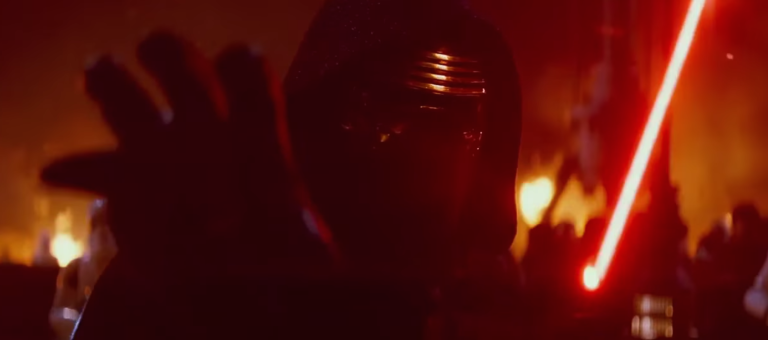
Screen Shot 2015-12-16 at 2.34.24 PM
Kylo Ren, from Star Wars Episode VII: The Force Awakens. Photo from the trailer, courtesy Disney
Republished from my Watching God blog on Patheos.
Kylo Ren isn’t all that he pretends to be.
When we first meet him in Star Wars Episode VII: The Force Awakens, Ren (played by Adam Driver) is doing his best to look, sound and act just like his idol, Darth Vader. He wears a fearsome black mask. He has a seriously wicked-looking red light sabre. He can telepathically choke people like nobody’s business. Like Vader, he serves as a spiritual leader to a galactic power—the First Order, an organization that resembles the old Empire but with a dash of ISIS-like zealotry thrown in the mix.
But perhaps Ren’s more like Vader than he even knows. That mask hides confusion, uncertainty. Maybe he’s not completely the plaything of the Dark Side just yet. And Lor San Tekka (Max Von Sydow) does his best to tease Ren back to the Light.
“The First Order came from the Dark Side,” San Tekka says. “You did not.”
It’s a deceptively powerful bit of theology thrown in the movie’s opening minutes. But maybe that’s not too surprising from a franchise that has boldly embraced spirituality from the very beginning.
The Star Wars universe has always been predicated on the Force. “ Life creates it, makes it grow,” Yoda says in The Empire Strikes Back. “Its energy surrounds us and binds us. Luminous beings are we, not this crude matter. You must feel the Force around you; here, between you, me, the tree, the rock, everywhere, yes. Even between the land and the ship.” And while The Phantom Menace seemed to suggest that this cosmic power could be explained by microscopic midi-chlorians—the more midi-chlorians you had, the more the Force was strong in you—The Force Awakens leans into more of a spiritual understanding. People talk reverently, almost lovingly about it, and even an old skeptic like Han Solo (Harrison Ford) seems to be a convert.
“The Force, Jedi, all of it,” he says. “It’s all true.”
That Force is divided between dark and light—warring elements that, paradoxically, exist in eternal balance. Folks like Luke Skywalker and Obi Wan Kenobi are able to tap into the positive energy of the Force. Vader and Kylo Ren seem to have a yen for the Dark Side.
These basic elements aren’t Christian, of course. Concepts like the Force and that sense of light/dark dualism owes a lot, I think, to Taoism, Zoroastrianism and perhaps a few other isms besides. But that said, how the Force manifests itself can feel pretty familiar to Christians like me.
When Taoism speaks of “light” and “dark” being in balance, it’s a lot more like the day/night, sun/moon, male/female sense of light and dark. But in Star Wars, darkness is plainly and irredeemably evil—not something anyone should really gravitate to, balance or no. You’ve got good guys, you’ve got bad guys. There’s no moral equivalency between them.
And here’s another interesting thing: The Dark Side of the Force is all about temptation: It’s not more powerful than the Light, but it is “quicker, easier, more seductive,” according to Yoda. The Dark Side is all about giving into your worst impulses. “Give into your hate,” the Emperor tells Luke. “With each passing moment you make yourself more my servant.” To follow the Light means exerting control on your own urges. The Dark Side merely asks for its acolytes to give themselves over to them.
Sounds an awful lot like sin to me.
But the Light has its own pull, too—and we see Kylo Ren struggle with its attractions. At one point, Ren addresses the crumpled, burnt mask of Darth Vader almost as if he was praying to a Catholic relic. “Forgive me,” he tells it. “I feel it again. The call to the Light.” And while the Light isn’t as sexy as the Dark, it appeals to Ren on a different level.
See, like Ren, we Christians believe we weren’t made to be creatures of the Dark Side. We were made by God in His image, to be reflections of His glory. Alas, sin has pulled us out of the Light. We make mistakes, we long for the wrong things, we give into our worst inclinations sometimes. But the Light still calls us always. I think most of us feel His pull. Our temptations and sins—gifts of God twisted beyond recognition—came from the Dark Side. But we did not.
And like Christianity, Star Wars tells us that it’s never too late to find the Light, to find a better way forward. Darth Vader, as terrible as he was, found redemption in the end—salvation through sacrifice. Pretty resonant stuff.
Kylo Ren wants to follow the Dark Side. If the mask wasn’t clue enough, he makes it pretty clear at the beginning of The Force Awakens. But the Light hasn’t given up on him. Just like it hasn’t on us.

Sunday, November 29, 2015

We Need to See More Movies Like ‘The 33′

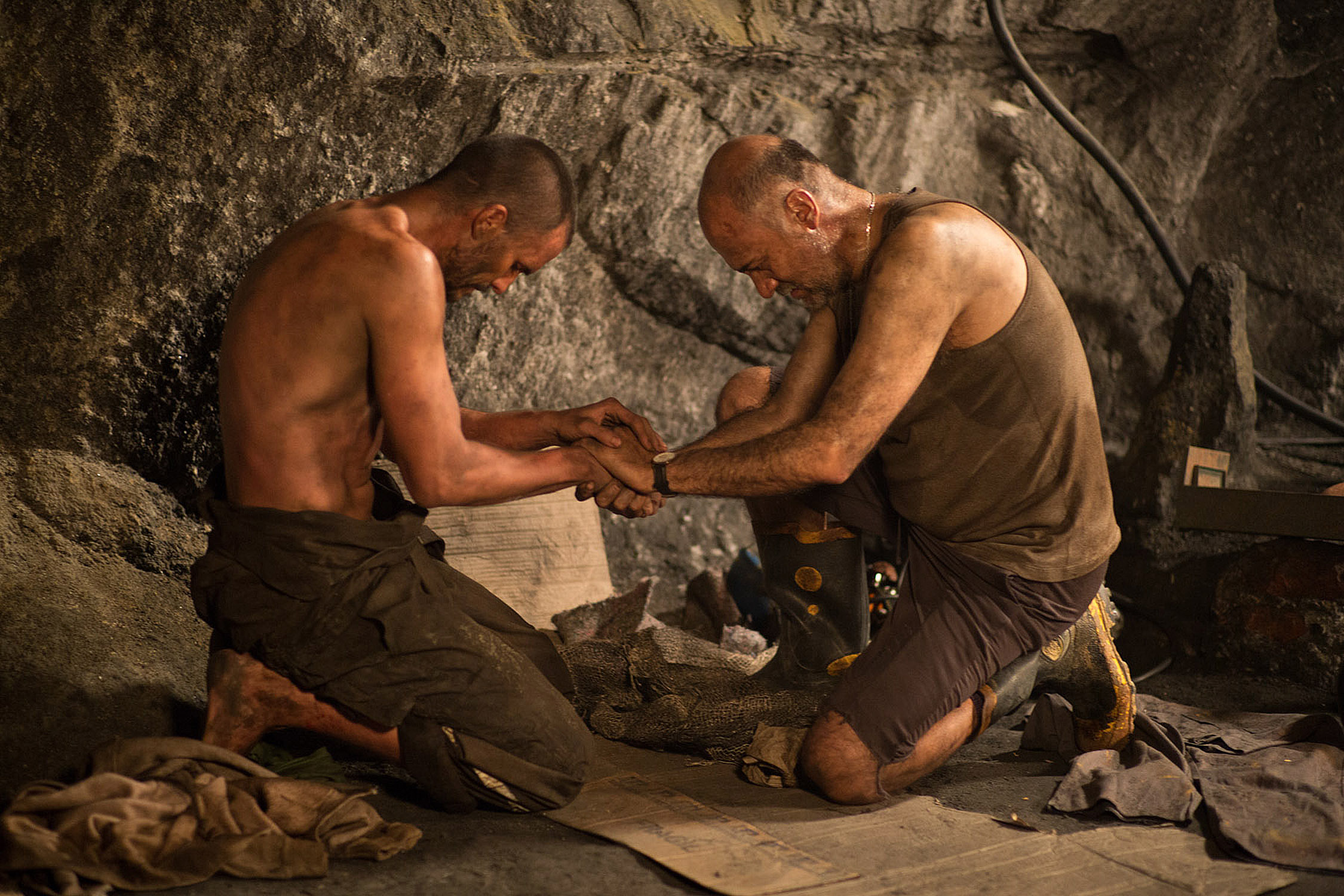
33 praying
Marco TreviƱo and Juan Pablo Raba from ‘The 33,’ photo courtesy Warner Bros.
Reprinted from my Watching God blog on Patheos.
Theaters are full of secular movies where God’s name is mainly used as a curse. A few make room for some Christian movies, too—cinematic sermons made specifically to bolster belief (sometimes at the expense of the actual movie).
There’s not a lot of room left, it seems, for movies that show the sort of faith that looks familiar to most of us—a faith that’s not particularly showy or splashy or supernatural, but one that nevertheless is with us every day, even in the most horrific moments in our lives. Maybe especially in those moments.
The 33 introduces us to group of miners trapped nearly a half-mile beneath the earth’s surface. Their situation is incredibly dire: Mining is a dangerous business, and rescues are as rare as accidents are common. Early on, it feels like the mining company’s already given the trapped men up for dead. “Nobody’s going to hear us!” foreman Don Lucho (Lou Diamond Phillips) says. “Nobody’s going to help us!”
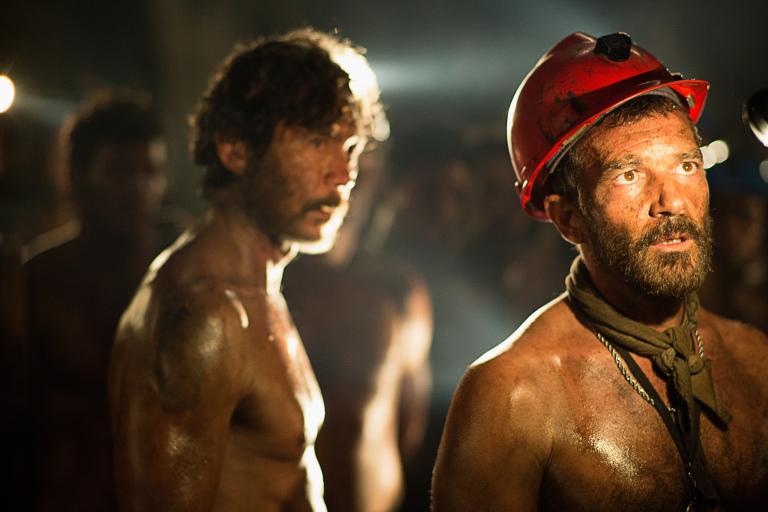
33 2
Lou Diamond Phillips and Antonio Banderas in ‘The 33,’ photo courtesy Warner Bros.
In a fictional movie, that’d be the cue for some serious special effects. Director Michael Bay would save the miners through some spectacular explosions. Eli Roth would surely have the miners kill and eat each other. A Christian filmmaker might give the miners a mysterious tunnel to the top and, if he’s feeling particularly devout, maybe a few angels to dig it.
But The 33 is based on a true story, and this story does not allow for cannibalism or supernatural miracles. Director Patricia Riggen and the other filmmakers needed to follow, more or less, the facts. And the fact is, many of them did what many of us would do if trapped under a literal mountain: pray.
Faith isn’t the prime theme of The 33, but it undergirds much of the movie. Catholic iconography is found everywhere, it seems—totally fitting within this predominantly Catholic country. When a miner leader named Mario (Antonio Banderas) divvies up the final bits of their food, the meal takes on a Last Supper-like quality: One of the miners even envisions Mary and Jesus stopping by.
During that meal, a miner named Dario (Juan Pablo Raba) offers up a handful of cookie crumbs for the miners to share. It’s a deeply significant gesture, given that two weeks earlier, Dario ransacked the food stores and stuffed handfuls of cookies into his face. Of all the miners there in the dark, he’s the only one who felt truly lost—a selfish alcoholic with no direction or purpose.
In my Plugged In review, I draw some parallels between the mine and our concept of a hot, dark, hell—and no one feels that hell as sharply as Dario. Indeed, the mine becomes a place of torment for him, wracked by alcohol withdrawal and anguished regret.
But a miner known mainly as “the Pastor” befriends Dario and, in the midst of Dario’s torture, comes alongside him and comforts him. “We can say a prayer together, if you like,” he offers.
“I don’t know the words,” Dario says.
“God doesn’t care.”
We’ve seen sinner’s prayers in many a Christian movie, and sometimes they can feel forced and hokey. But in this context, it feels natural. It feels right.
“Lord, to whom shall we go?” Peter asked Jesus when many other disciples were turning their backs on Christ. And there, in that pit, Dario’s turn to God bears a hint of Peter’s desperation. Like Peter, there was nowhere else for Dario to turn in that darkness. Like Peter, there were just two choices left to him: A life (whatever the rest of that life might look like) of hope and redemption, or of a turn to death. When you can’t save yourself, you must look for a savior.
THE 33
From ‘The 33,’ photo courtesy Warner Bros.
All the miners are, more or less, in a similar spot, relying on someone else to save them. They cannot escape the mine on their own. They must wait and hope and trust. They must have, in a very real sense, faith. And faith is a choice.
“I believe we’re going to make it out of here because I choose to believe it!” Mario thunders. “All 33 of us!” He chooses to believe in spite of the odds. In spite of the countless tons of earth above their heads. And faith is an incredibly powerful thing.
Mario and the miners weren’t waiting for a supernatural miracle—for that huge rock that blocked their way to magically vanish. But I believe their faith—in their ability to endure, the people topside and, yes, their faith in God—helped them to survive.
After 69 days, their faith was rewarded. Every one of those miners returned to the world of the living after more than two months in darkness. Before taking the strange elevator out of the mine, Mario scrawls on a wall, “God was with us.”
Faith doesn’t always move mountains. Sometimes, it’s enough for it to shed a little light inside them.

Sunday, November 15, 2015

Spotlight: The Importance of Being Honest

“Everything in your life is public. There are no secrets. Everything you say, everything you do, everyplace (sic) you go, every thought you think is going to be known by all.”
Ted Haggard—one-time pastor of Colorado Springs’ massive New Life Church, one-time president of the National Association of Evangelicals—wrote that in his book Letters from Home. Those words proved sadly prophetic: In 2006, a male prostitute came forward, alleging that he and Haggard had had sex and used methamphetamines.  Haggard—one of the most powerful men in the evangelical movement at the time—was removed from the pulpit and became a national punchline.
I covered Haggard’s fall in 2006 as a secular religion reporter for the Colorado Springs Gazette. Those words, soaked in irony, were strangely comforting as I pushed through this difficult story. And I remembered those words again as I watched Spotlight, one of the year’s best movies.
There are no secrets.
spotlight4
From Spotlight, courtesy Sony Pictures
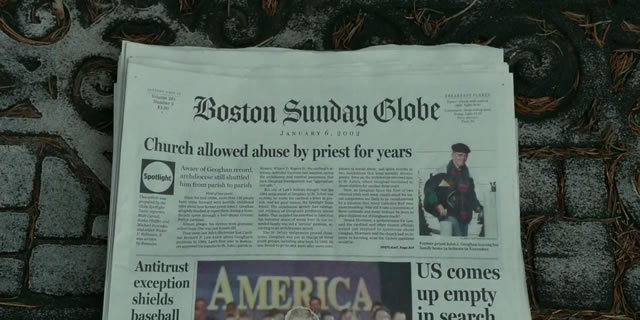
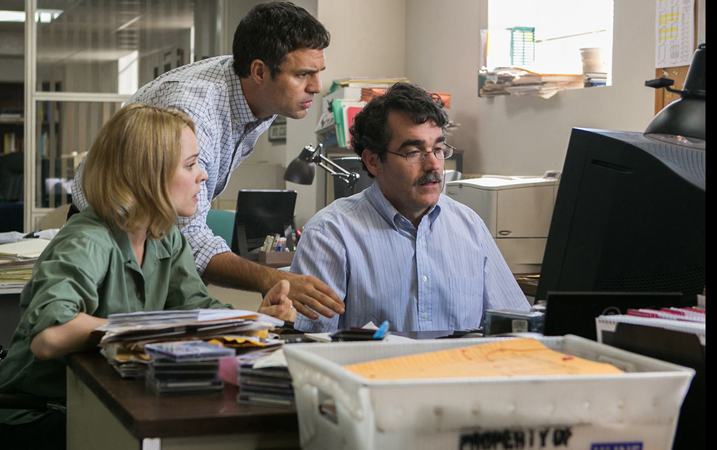
Spotlight is a terrifically unsentimental story about how a team of Boston Globe journalists uncovered the pedophilic priest scandal in 2002. While the movie doesn’t yank at the heart like, say, Roomdoes, it feels utterly real. Utterly true. The detached zeal of the Globe’s reporters reminded me of the journalists I’ve worked with. The stories from abuse victims sounded very similar to what I heard during my own interviews when I covered the scandal—the reverence to which parish priests were held, and how those priests used that reverence for their own ends. “How do you say no to God, right?” one victim says. Spotlight felt spot on.
When the film begins its narrative in a pre-scandal, pre-9/11 world, the Diocese of Boston is arguably the most powerful institution in this predominantly Catholic city. Millions turn to the Catholic Church for guidance and solace. Its charities help countless people. It’s not a perfect institution: No one claims it is. But it’s inconceivable to most folks in Boston, including those who work at the Globe, that the Diocese would be hiding the darkest of secrets.
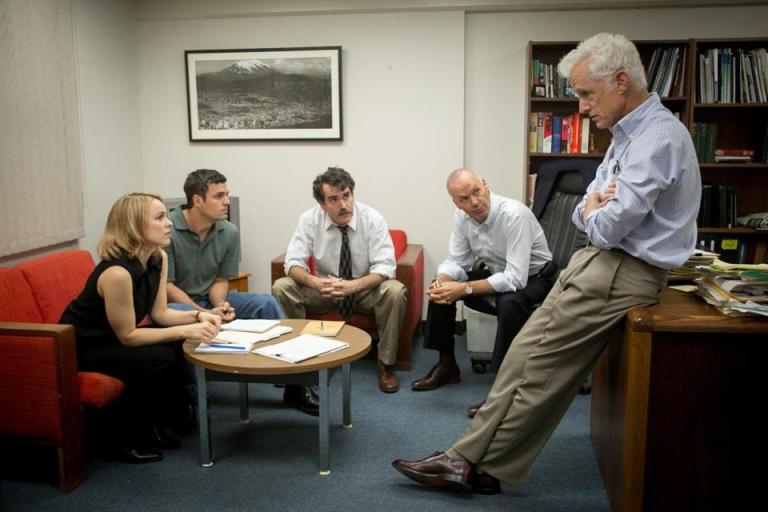
from Spotlight, courtesy Sony Pictures
But as the Globe’s team of investigative reporters (known as Spotlight) begins digging, they discover that some of the diocese’s priests have been abusing young children. When parents come forward, the diocese sends them to other parishes or dioceses, where they’re free to molest again.
The Diocese tries to quash the investigation. One of its legal advisors appeals to Spotlight editor “Robby” Robinson’s sense of community and continuity. Robby (Michael Keaton) attended Catholic schools. He sees the good the charities do in the community. Don’t rock the boat, the lawyer suggests. Don’t destroy all the good the Church does because of a few bad apples.
But the Spotlight team pushes forward, and the story becomes ever more unseemly. It takes a toll on the reporters, too: Reporter Sacha Pfeiffer (Rachel McAdams), a reporter who sometimes celebrated Mass with her grandmother, says she just can’t go to church anymore: It makes her too angry. Fellow reporter Michael Rezendes (Mark Ruffalo) oozes fury. “They knew, and they let it happen!” he shouts. “To kids! It could’ve been you! It could’ve been me! It could’ve been any of us!”
And he had a right to be angry. Every Catholic did. It was a horrible story … and one that needed to be told.
When I was covering the Haggard scandal, many folks from his church didn’t understand my job and hated the fact that I was doing it. I was kicked out of the church one time. I got some pretty nasty e-mails. One official there once asked me, as a friend, not to print a follow-up. It’d destroy the church, he said. It’d hurt all the good work it had done.
I couldn’t do him that favor, of course. I wrote the story. But I understood the instinct to protect the church—protect an institution that means so much to so many people.
spotlight2When we love something, we want to protect it. And so, when the something or someone we love does something bad, our instinct for self-preservation kicks in. We deny or rationalize or hide the sordid truth.
But if our faith means anything at all, we have to be honest about those who do terrible things in its name. It’s only through ruthless truth-telling that our earth-bound Church can better reflect its heavenly ideals. It’s only through exposing its flaws that we can fix them.
The Catholic Church is smaller than it was before the scandal, but I think a better and cleaner one now. A review via the Vatican’s radio outlet praised the movie, and lauding the reporters who inspired it.
“It was a group of professional journalists of the daily Boston Globe that made themselves examples of their most pure vocation,” said Luca Pellegrini, who often comments on pop culture for Vatican Radio, “that of finding the facts, verifying sources, and making themselves—for the good of the community and of a city—paladins of the need for justice.”
Ultimately, there are no secrets. Lots of verses make that very clear. “For God will bring every deed into judgment, with every secret thing, whether good or evil,” we read in Ecclesiastes 12:24. And I think that goes not just for our own personal secrets, but the institutional ones, as well. As Christians, we’re not supposed to just sell a Facebook version of our faith. We’re to be honest.
Spotlight is not a movie that’ll strengthen anyone’s faith. The truths told here are too brutal for that. But it’s an important story to tell, and an important one for us to hear.

Sunday, November 1, 2015

Jobsenstein: The Odd Similarities Between Two Very Different Movies

Republished from my Watching God blog on Patheos.
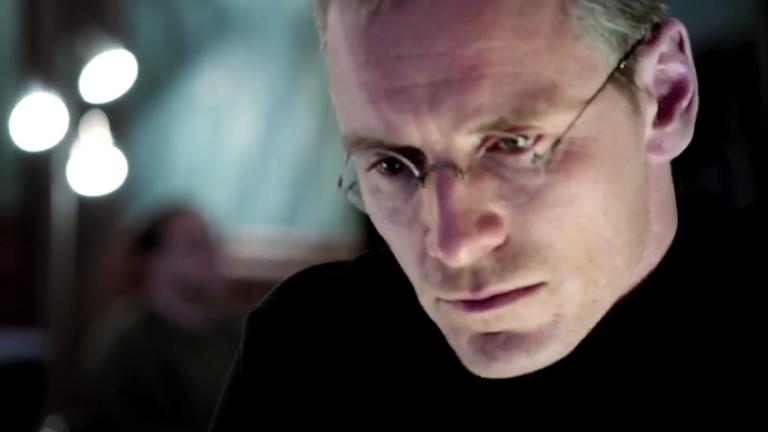
In Universal Pictures Steve Jobs, we meet a brilliant, flawed protagonist—a man who demanded his gadgets be friendly and intuitive even though he (according to the film) was neither.
Michael Fassbender may well get nominated for an Oscar for his portrayal of Jobs, and it may seem odd that Universal rolled it wide the weekend before Halloween, the same time when frightflicks like The Last Witch Hunter and Paranormal Activity: The Ghost Dimension are trying to scare up some cash.
But I think Steve Jobs might be, curiously, a perfect fit for this spookiest of seasons. I watched 1931′s Frankenstein the night before I saw Steve Jobs, in fact, and I was pretty amazed that the parallels between the film’s two eponymous characters went far beyond the fact that their most famous creations were susceptible to heat.
jobsenstein5
Fritz, threatening the Monster’s mother board. (Courtesy Universal Pictures)
Consider:
Both had a bit of a God complex. Dr. Victor Frankenstein—the mad scientist, not the monster—was considered a pretty brilliant guy even before he started stitching body parts together. His old mentor, Dr. Waldman, said as much. But mere brilliance wasn’t enough: He wanted to change the world. And when it looked like his little world-changing experiment worked, he was exultant. “Now I know what it feels like to be God!” he said.
When Steve Jobs prepares to unveil his Macintosh in 1984, he declares it to be one of the greatest achievements of the 20th century—right alongside the end of World War II. But when it looked like the demonstration might go awry, he tells his engineering lackey Andy Hertzfeld (Michael Stuhlbarg) that he must’ve squandered the three weeks to get it right. “The universe was created in a third of that time,” Jobs says.
“Well, someday you’ll have to tell us how you did it,” Hertzfeld said.
Jobsenstein3
“If a fire causes a stampede to the unmarked exits, it’ll have been well worth it for those who survive.” quote from Steve Jobs. (Picture courtesy Universal Pictures)
Their first products flopped. Both Jobs’ Macintosh and Frankenstein’s monster had trouble talking at first: During the 1984 Mac demonstration, Jobs and Hertzfeld hook up the Macintosh’s “voice” up to a more powerful computer before it could utter its famous “hello.” And the monster … well, he also had to wait for a system upgrade. He never got the hang of speech until The Bride of Frankenstein.
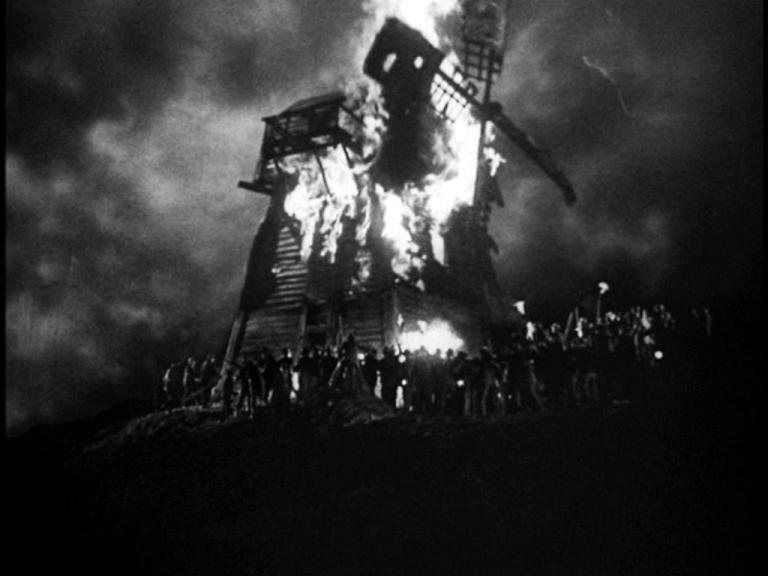
Those products nearly destroyed their creators.  Mac was indeed a revolutionary product. But it undersold, nearly broke Apple and eventually gets Jobs fired. But at least Jobs has the solace that the Mac didn’t become sentient and try to kill him in a deserted, crumbling windmill.
Jobsenstein1
“Reboot! Reboot!” (Photo courtesy Universal Pictures)
Both wanted to improve humanity. Neither Jobs nor Frankenstein really had much patience for human frailty or sensitivities. “The very nature of people is something to overcome,” Jobs insisted. He designed gadgets that were intuitive and friendly—intending them to be extensions of our own selves. And he did it with an eye toward human shortcomings.
Maybe Frankenstein’s creation was also intended to be sort of a human upgrade. It was bigger and stronger, that’s for sure—and like the original Mac, it had a remarkably square frame. I’m sure that the good doctor would argue that only an abnormal brain kept his creation from reaching its true potential.
Both had issues with women. Frankenstein practically ignored his fiancĆ©e, Elizabeth, while working on his monster. In fact, he barely deigned to let her into his secret laboratory … even though she was about to get swept off the side of a mountain in a huge lightning storm.
Jobs was likewise focused on the work at hand, shunning his onetime girlfriend Chrisann Brennan (Katherine Waterston) and denying the paternity of his daughter, Lisa (Makenzie Moss) for way too long. Thankfully, both Jobs and Frankenstein patched things up with the most important women in their respective lives—but not before each had to suffer the sting of failure.
jobsenstein6
The Monster wasn’t particularly adept with female companionship, either. (Photo courtesy Universal Pictures)
Both inspired copycats. Frankenstein was ostensibly through with monster-making when Dr. Pretorius came knocking, hoping to leverage the doctor’s innovations into another, better, prettier creature. As for Jobs’ creation … well, all you have to do is look around. There’s a whole (ahem) galaxy of products designed as iPhone or iPad or iMac “killers”, designed to be better or faster or, at the very least, cheaper than the originals.
In summary, Steve Jobs was, without question, an original thinker—a self-made man, if you will. But Steve Jobs, the movie, seems to owe something to a cinematic mad scientist who took “self-made man” to a whole different level.

Sunday, October 25, 2015

How the World’s Worst Movie is Technically Christian

Reposted from my Watching God blog on Patheos.


I have a soft spot in my heart (and possibly on the brain) for bad movies. If there’s anything I like more than a good movie, it’s an awful one. And this may be a good thing, given my line of work. While I believe Christian movies are getting better, and sometimes they’re even pretty good, some of them are … well, not.

But would it surprise you to learn that Plan 9 From Outer Space—considered by many to be the worst movie ever—is technically a piece of Christian cinema? No, really, it’s true. Hear me out.
For those unfamiliar with the glories of Plan 9, a quick recap (as near as I can remember): Aliens invade earth and begin raising folks from the dead to, I guess, frighten all of humanity so much that they’d stop making bombs. Here’s how the movie started:

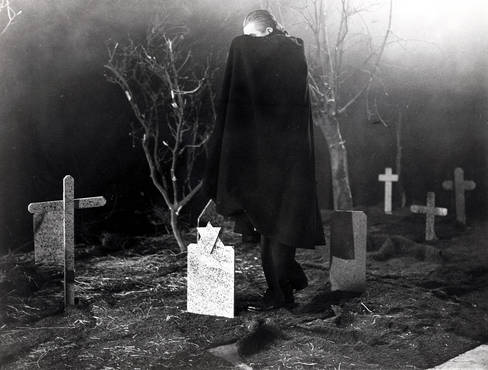
Made by legendary anti-auteur Ed Wood in 1956 (but not released until 1959), this story of zombie-vampirism, space invasion and government conspiracy featured none other than the great Bela Lugosi as, of course, a zombie vampire.
plan 9 lugosi
Bela Lugosi, Plan Nine from Outer Space
Alas, he died early on in the movie, so Wood hired his wife’s chiropractor to fill in. Since the guy was several inches taller than Lugosi and looked nothing like him, the chiropractor (Tom Mason) spent his screen time stooping and covering his face with his cape. But really, that’s just a minor tic in Plan 9‘s shivering mass of terribleness. Given its cardboard gravestones, floating flying saucers and wonderfully weird dialogue, no wonder that it was dubbed in 1980 as “the worst movie ever made” by Michael and Harry Medved.
plan 9 not lugosi
Not Bela Lugosi, Plan 9 From Outer Space
Who would’ve financed such a movie, you ask? Well, turns out, the Baptist Church of Beverly Hills. “Ed had convinced them that they should finance a film with the teenage appeal of the time,” writes Susan MacDonald in “The Dreamscapes of Edward  D. Wood Jr.”, “and that this film would then generate the money needed to make twelve films about the apostles of Christ—which were the movies that the Baptist Church of Beverley Hills really wanted to make.” But before the church forked over the money, they insisted that the whole cast be baptized. So they were.
And according to Rob Craig’s book Ed Wood, Mad Genius: A Critical Study of the Films, two of the church’s leaders play gravediggers, uttering these immortal lines:
“Don’t like hearin’ noises—’specially where they ain’t supposed to be any!”
“Yeah! Sorta spooky-like!”
So there you have it: You can look at this little fact as proof that the church helped contribute something truly, utterly unique to the canon of American film … or that Christian movies have been bad for a long time.

Sunday, October 11, 2015

Phil Vischer and the Theology of Jellyfish

Originally posted on my Watching God blog on Patheos.
Phil Vischer has always been one of my favorite storytellers. My kids drew up watching Vischer’s VeggieTales—a rare faith-based product that was both seriously Christian and delightfully entertaining—and he’s continued telling stories through his JellyTelly characters, headed by the intrepid big-headed puppet Buck Denver.
But his latest feels like one of the most personal stories he’s told yet.
“You might even call it autobiographical,” Vischer told me.
1008galaxybuckIn Galaxy Buck: Mission to Sector 9 (available onOct. 11 here and lots of other places), Buck has made a career change—from “Man of News” to a phone jockey in a galactic parachurch ministry. And while one should never look down’s one bulbous felt nose at gainful employment, Buck does bridle at spending his days in a non-descript cubicle. He keeps a poster that says “God wants you to do big things,” and he just doesn’t think shipping out tote bags really fits the “big things” bill.
But when he gets the chance to do something really big—hop in a spaceship with his own fearless crew to fix a transmitting station on an (ahem) uninhabited planet—things go Martian in a hurry. A sandstorm whips up. His crewmates disappear. A critical transmitter component is oddly missing. And Buck soon finds himself in the company of a strange, old hermit who promptly tears Buck’s prized poster in two.
He gives the top half—the half that says “God wants you”—back to Buck.
“I need the other half,” Buck says.
“No you don’t,” the hermit insists.
And he takes Buck on a tour of his jellyfish farm—suggesting that it’s the jellyfish who get what we Christians are supposed to be doing. We’re supposed to float on the current of God’s love and take it to where He takes us. Buck doesn’t need to stress himself out over the need to do “big things” for God. God isn’t interested in our performance. He’s just interested in us.
Vischer knows all about trying to do big things for God. VeggieTales, the core product of Vischer’s Big Idea Entertainment, was a runaway phenomenon in the late 1990s. But the company eventually collapsed—a history that Vischer himself unpacks in ablog. “I wanted to build the next Disney,” he wrote in 2004. But to achieve this—to do this “big thing”—required more money, more people, more effort and, as it turns out, a great deal more debt. Eventually the whole thing fell apart after the release of Jonah: a VeggieTales Movie. Big Idea went into bankruptcy and the VeggieTales brand was sold.
“Following God starts with a relinquishment of your own ego, your own goals,” Vischer says. It was a painful lesson, and one he shares in talks at churches and college campuses across the country. Now, he’s teaching the same lesson to the children and families he’s been reaching for most of his adult life, using it as a counterbalance to one of the culture’s most seductive themes.
1008 phil vischerChildren’s programming is often replete with messages about following your dreams, according to Vischer. “There’s the assumption in there that if I want it, it must be good,” he says. “But just because I want something, is it automatically good for you?” Even kids get that that’s not true, Vischer adds, “but once we start using the language of dream, there’s a moral implication.”
Vischer’s trying to simply hang out in the current of God’s love these days: No accident that he calls his new business Jellyfish Labs. And instead of spending months and months crafting a computer-animated VeggieTales story, Buck Denver and his gamut of puppets allow him to turn things around much more quickly and be a bit more spontaneous, too—particularly in his popular podcasts.
He talks about the four years and the millions of dollars he and his team spent makingJonah. When it was all done, the team still had to piece together some extras for the DVD—including an audio commentary featuring Mr. Lunt (voiced by Vischer) and Larry the Cucumber (Mike Nawrocki).
“We ad-libbed the whole thing,” Vischer says, “and it was funnier than the movie was!”
‘Course, being funny isn’t something that Christians always do well, even Christian entertainers. And Vischer admits that it’s a ticklish thing to pull off. “People who make Christian films are usually deadly serious,” he says. They go into their stories hoping to save audiences from hell itself.
“I’ve got to save them,” Vischer says, stepping into the shoes of a Christian storyteller, “and hey, that made me just think of something funny!”
It makes what Vischer does all the more remarkable, I think.
“I’m not a pure storyteller,” he admits. “I would have a hard time writing a novel—500 pages with some hinted-at lessons.”
Which is fine. As Buck Denver himself might say, God doesn’t call us all to write big books. But Vischer, as a hybrid teacher and storyteller, has found a nice sweet spot for himself, has made a pretty big difference.

Sunday, October 4, 2015

The Walk: A High-Wire Act That’s Not About Faith (But Sort of Is)

This was originally posted on my Patheos blog, Watching God.
When I was youngish, a friend of mine and I went to check out the Black Canyon of the Gunnison during a camping trip. It looks something like this.
0930 BlackCanyon
Photo courtesy Wikimedia
Very pretty, yes? But it’s also a long way down from the ridge of the canyon to its rocky, watery bottom. A really, really long way down. So my friend and I—brave, stupid fellows who once tried to break through the ice on a lake while standing on it—literally crawled on our hands and knees to look over the edge. Heights are not really our thing.
This made me, perhaps, not the best person to see The Walk.
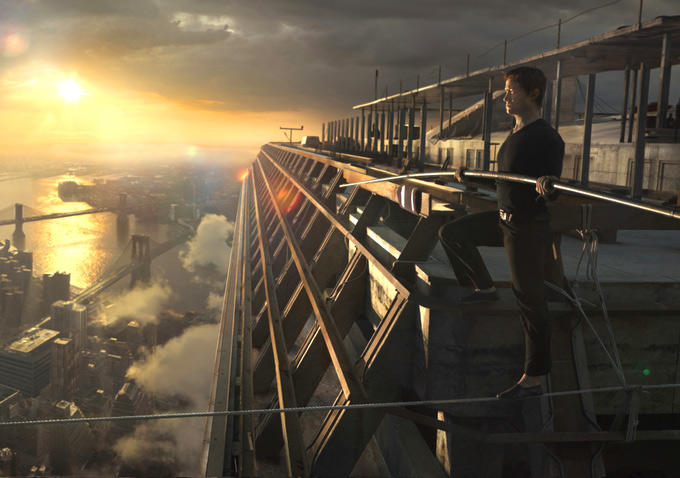
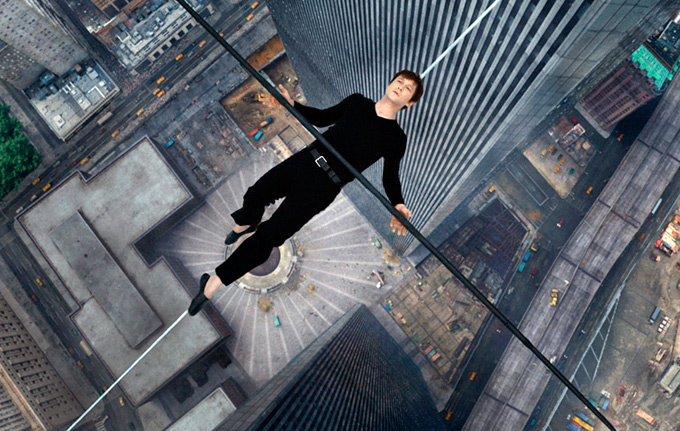
The Walk, for those of you who don’t know, is based on the true story of Frenchman Phillippe Petit’s illegal 1974 high-wire performance between World Trade Center towers. In real life, Petit spent about 45 minutes on that wire, walking and kneeling and lying down on a thin cable of steel 110 stories above the Manhattan streets. In the movie, it felt like a couple of weeks. It’s intended, I think, to be a film saluting Petit’s bravery, ingenuity and sheer stubborn will. Given my mild acrophobia, I just wanted the guy to get caught before he even started his walk. The ground’s not so bad, Phillippe. Really.
Had I been thinking about how this little tightrope stunt would impact me—in 3-D IMAX, no less—I would’ve brought in a bottle of Tums.
This is not a knock on the movie. Really, it illustrates just how effective it is. And even for me, the flick had some pretty beautiful moments in it.
0930 the walk 1
Joseph Gordon-Levitt in The Walk
For instance, the moment when Petit (played by Joseph Gordon-Levitt) first steps onto the wire stretching between the two towers. Clouds envelop the scene, and the wire vanishes in a blue-cotton haze in the distance. Petit speaks of the comfort that comes from placing his foot on the wire—how it supports him, how the towers support the wire.
And in that moment, it felt like a picture of faith.
Faith and tightrope walking, oddly enough, have a strange, shared history. Nik Wallenda, the tightrope walker who walked over Niagara Falls in 2012, is a Christian whose faith is instrumental in his work. “I grew up in a born-again Christian family,” he told QMI Agency at the time. “That’s the way I was raised and I find comfort and peace in that.” Loads of preachers have recounted the story of another famed French tightrope walker, Charles Blondin, who walked across the falls in 1860. He allegedly performed many great feats on that line, including pushing a wheelbarrow full of potatoes across it.
“Do you believe I can carry a person across in this wheelbarrow?” he allegedly asked the crowd gathered at the edge of Niagara Falls. “Yes!” the crowd shouted. But when he asked for volunteers, not a one of them took Blondin up on the trip.
It’s an illustration, pastors say, of a weak faith: We say we believe, but do we? Do we really?
I thought of that illustration as I watched the end of The Walk—Petit held up by this thin cord. Petit trusted. He had faith.
It was not a blind faith: He calculated the weight of the wire needed, the stabilizers it would require, all manner of eventualities. He’d been a tightrope walker for years, even practicing on wires that his friends would tug and yank, replicating the high winds he might expect 110 stories up. He trusted his skills, his equipment, his friends.
But the stunt required a severe, unblinking sort of faith even so. Any sensible man might still look at the wire—stretched nearly 1,400 feet up in the air—and grow fearful. I mean, how could a sensible man not? But Petit was taught by his mentor, Papa Rudy (Ben Kingsley), that fear and doubt mean death. When Petit feels an inkling of doubt during his training in the movie, the wire shakes and buckles. Sometimes, Petit falls. He has the skills to make it across, no doubt. But if he doubts his skills? Loses heart in the moment? If he lets the wire’s height or length get to him? There’s no way Petit would make it across.
“It’s impossible,” Petit says. “But I’ll do it.”
0930 the-walk-joseph-gordon-levitt
Joseph Gordon-Levitt in The Walk
I was reading a story the other day bySalon’s Darin Strauss about how difficult it is, in this age of rationality, to have faith. “How, against a contemporary background, do you contemplate the almighty?” he wrote. “Who believes there’s an oasis in 2015’s scattered metaphysical sand?” Some say that it’s impossible to believe in God today. Foolish, perhaps. The ground’s not so bad.
But yet, those of us who believe in God feel our faith underneath our feet, holding us up. We feel the strength of what our faith is attached to. This is not a strange, frightening place; it is life itself. We believe. And we walk.
“The wire is a safe place for me to be,” Phillippe Petit once said. “It’s a rigorous and simple path. It’s straight. You don’t have meanders like, you know, on the ground, in life.”
Funny how walking as a Christian is often characterized in the same way. Rigorous. Simple. Straight.
I can’t claim to be free of fears or doubts. If my faith is a wire, it sometimes shakes. I sometimes fall. But I do have faith—faith that something special is waiting on the other side.

Sunday, September 20, 2015

The Season of the Sorta-Secular Christian Movie

Originally published at my Watching God blog at Patheos.org.
Last year was called the year of the faith-based movie, and in a lot of ways, it was. Three straight-up Christian flicks (Heaven is for Real, God’s Not Dead and Son of God) each made more than $50 million. Another two movies theoretically made with a faith-based audience in mind—Noah and Exodus: Gods and Kings—banked even more. Only problem: Secular audiences had no use for the former, and most evangelical Christians kinda hated the latter.
This fall, though, we’re about to see a different sort of faith-based movie in theaters. And it’ll be an interesting gauge whether Christians can get excited about “Christian” movies that don’t feel like Christian movies.
captive
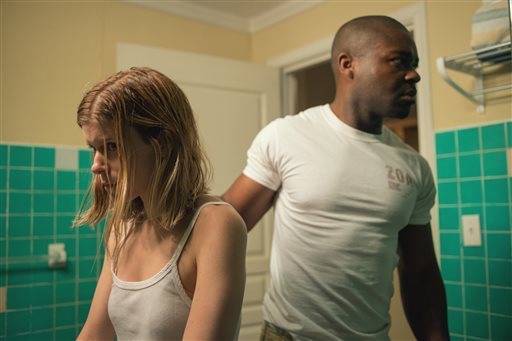
Kate Mara and David Oyelowo in Captive
Up first: Captive, released this very day. The movie’s stars, David Oyelowo (who was robbed of an Oscar nom in Selma), and House of Cards’ Kate Mara, aren’t the sort you’d expect to show up in a Christian movie—but then again, this doesn’t feel like your typical Christian movie, either.  It’s a rough, story dealing with messy subjects and involving not a small amount of tension. Yet Captive is unquestionably a Christian story—so ridiculously Christian, in fact, that most faith-based filmmakers would’ve rejected it out of hand for being way too improbable had it not been absolutely true.
In 2005, Brian Nichols (Oyelowo)—on trial for rape—escaped from an Atlanta courthouse, killing four people en route to the apartment of Ashley Smith (Mara). He held Smith hostage for seven hours, and no one would’ve been surprised had he killed her, too. But during their time together, Smith read portions of Rick Warren’s Christian bestseller The Purpose Driven Live, and he eventually let her go.
Oyelowo is an outspoken Christian. But he had no desire to make a typical Christian movie.
“Yes I’m a Christian myself, but I’m not particularly interested in quote-unquote preaching to the choir,” Oyelowo told the Los Angeles Times. “I am a big believer in the potency of artistic endeavor at its highest. To proselyte through your storytelling is not good storytelling.”
And then there’s The 33, to be released Nov. 13. It’s another true story, this one focused on the Chilean miners who were trapped in a mine for a staggering 69 days before they were finally—some would say miraculously—rescued.
It’s technically a secular movie, this one from Warner Brothers. Starring Antonio Banderas, Lou Diamond Phillips and Academy Award-winner Juliette Binoche, The 33has the pedigree of a solid independent film. But it doesn’t shy away from the deep faith of many of the miners (it even features a wayward miner finding salvation) or the fact that many saw divine providence in the rescue.
the-33
Antonio Banderas in The 33
“We realized we had only one alternative, and that was God Himself,” said miner Jose Henriquez, known by his fellow miners as “the pastor,” said at the 2011 National Prayer Breakfast in Washington D.C.
For a movie-lover like me, this is a pretty encouraging trend. While traditional Christian movies are getting better (and, obviously, some have even found financial success), most  are still not flicks you’d invite your agnostic friends to without blushing a bit.  And when secular studios try to woo Christians with big-budget epics and powerhouse directors (Darren Aronofsky directed Noah, and Ridley Scott helmed Exodus), they often show a certain tin ear when it comes to what most evangelical Christians actually want to see.
The fact that it’s a little hard to classify both of these movies as straight-up “Christian” or flat-out “secular” is encouraging, too. Captive is a Christian movie that honors the art. The 33 is a secular movie that honors the story’s intrinsic spiritual backbone. These fall movies not only take faith seriously, but they’re seriously watchable, too.
But will anyone watch them? These are smaller movies, after all—not superhero-laden blockbusters guaranteed to make 16 bazillion dollars. And while faith-centric moviegoers have shown a willingness to go to theaters if they have something to see, they can be a pretty persnickety bunch. And neither movie is as squeaky clean as some Christians demand.
“[Captive is] a little bit messy,” admits Captive co-producer Terry Botwick to the LA Times. “But that’s where the truth of it is.”
And that, I think, is often where the truth is often found: In the mess. Christianity was founded on a messy execution, after all. The world in which Jesus walked was hardly pristine. As Christians, I don’t believe that we’re supposed to ignore the grit and grime of the world, but rather see it clearly and do something about it.
Christian movies shouldn’t be needlessly gratuitous. But I’d argue they don’t need to be ruthlessly sanitized, either. There will always be space in Christian cinema circles for strong, clean, inspiring Christian stories. But I’m hoping there’s a future for unapologetic faith-based movies with a little grit, too.

Sunday, August 30, 2015

Attention Hollywood: Here’s What Moviegoers Actually Want to See

Originally published at my Watching God blog at Patheos.org.
It’s been a great year for women in movies. Check out the year’s 15 top-grossing films, and you’ll see that a majority of them—from Inside Out to toPitch Perfect 2 to Mad Max: Fury Road—feature strong women in leading roles.Time, Forbes and io9 have all noted what a great year it’s been for girl power, and all I can say is, it’s about time.
How Hollywood ever got the idea that blockbusters have to be anchored by men is a little mystifying—particularly in an age where there are so many fantastic female actors out there who can bring depth and drama to any role. Here’s to hoping that Kate Blanchett gets her own action franchise.
But as the summer movie season comes to a close, there’s another trend to make note of.
Take a look at that Top 15 list. How many R-rated movies are on it? Two. Fifty Shades of Grey at No. 9 and Mad Max: Fury Road at No. 14.
How many R-rated movies have been released so far this year? About 126, according to Box Office Mojo—out of 226 total rated by the MPAA in 2015. That means more than half of Hollywood’s output (56%) has come in the form of R-rated movies.
Another illustrative, stat: The average R-rated movie in 2015 has made $12.1 million. MPAA movies rated G, PG or PG-13 rake in an average of $48.3 million.
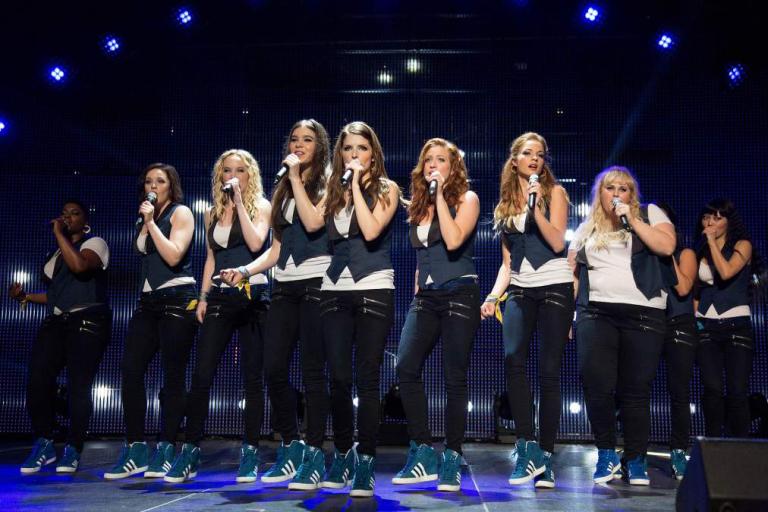
Pitch Perfect 2
Pitch Perfect 2, Universal
Hollywood is beginning to understand that women can front big, successful flicks—and for their own well-being, it’s important that they do. The entertainment industry is a business, after all. It’s important to understand what people want to see.
So why so many R-rated movies?
Now, I’m not hating on the R. I believe that some stories, to be told well, need harsh content. Schindler’s List and 12 Years a Slave wouldn’t have had the same resonance without it. But I don’t buy that f-bombs and exposed intestines inherently make for good storytelling, either. In fact, I think gratuitous content is often used as a substitute for it.
When I watch old Hays code-era films—movies made between 1930 and 1968 under strict moral guidelines on what could be depicted onscreen—I don’t see stunted storytelling. I’d argue that, often, the restrictions in place enhanced it, forcing moviemakers to be more creative. Indeed, the Hays Code era encompasses many of the greatest films ever made. Don’t try to tell me that Citizen Kane would’ve been so much better with more swearing, or that Casablanca would’ve been more moving if we saw Rick and Ilsa in the sack. I don’t buy it.
Indeed, the less content a movie has, the better it does. There are five PG movies in the year’s Top 15: Inside Out, Minions, Cinderella, Home and The SpongeBob Movie: Sponge Out of Water. Only 15 G or PG movies received anything close to a wide release this year—and a full third of them are among the year’s most successful movies.
Cinderella
Cinderella, Disney
None of this is breaking news, of course. Since the Hays Code was abolished in 1968, moviemakers have always made far more R-rated movies than we’ve ever wanted to see. In 2013, the National Association of Theater Owners pleaded with Hollywood to turn down the R-rated spigots. “Make more family-friendly films and fewer R-rated titles,” said the organization’s President John Fithian. “Americans have stated their choice.”
Alas, the entertainment industry continues to chase the same mythical moviegoer that, I think, kept it from acknowledging the inherent draw of woman protagonists for such a long time: The 20-something male who likes his jokes profane, his women objectified and his cinematic action coated in a sheen of gore.
Do such men exist? Perhaps. But they’re not going to movies like they used to, apparently, and Hollywood’s never-ending pursuit of them leaves moviegoers like me—and perhaps like you—with fewer options than we’d like.