Showing posts with label Disney. Show all posts

Saturday, November 15, 2014

The Little Mermaid: Like the Garden of Eden, Only Wetter

The Little Mermaid opened in theaters 25 years ago Monday (Nov. 17). It proved to be a pretty significant day in the annals of animated filmdom, marking not just the beginning of Disney’s fabled renaissance (Beauty and the Best, Aladdin and The Lion King followed hot on the Mermaid’s scaly heels) but also an unrivaled run of animated excellence across the industry. Mermaid’s artistic and commercial success helped lead to Toy Story and How to Train Your Dragon, Despicable Me and Frozen. Before The Little Mermaid, animated films were, really, cartoons—meant for kids and tolerated by adults. Mermaid reminded us that these things could be art, and contain a pretty powerful story, too.
Some don’t see it that way. Willa Paskin, writing for Vulture in 2011, said, “What’s most striking about The Little Mermaid now is that it’s a kids’ movie, but from a time before studios were even aware that parents would have to watch these things too.”
But truth is, The Little Mermaid was, and is, a story with crossover appeal: I was in college when it was released, and the thing was huge—so much so that many of my friends went en masse to see the thing. It’s a love story, a musical, and sometimes a campy delight. And it’s got some spiritual heft to it, too; perhaps unintentional, but still there.
Think of Ariel’s underwater world as a soggy sort of Garden of Eden.
It’s portrayed as a paradise—so much so that Triton’s head crab, Sebastian, can’t quite figure out why Ariel’s not completely satisfied with the place. In the deep theological treatise known as “Under the Sea,” he stresses that this underwater realm is completely free of worry and anxiety, pointing out that outside these watery walls things are much different: “Up on the shore they work all day/Out in the sun they slave away/While we devotin’/Full time to floatin’/Under the sea.”
He makes the whole of dry land sound a little cursed—almost like the curse that God laid on Adam back in Genesis 3:17-20: (“By the sweat of your brow you will eat your food until you return to the ground,” it reads in part.)
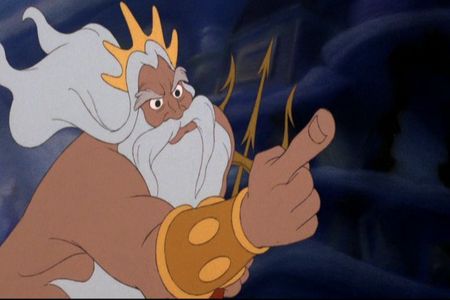
tritonBut Ariel is driven with a craving for forbidden knowledge—the knowledge of what’s outside this watery Eden. She collects terrestrial artifacts and eventually falls in love with someone who’s more comfortable topside, the handsome Prince Eric. Ariel’s father, King Triton (looking remarkably like Michelangelo’s version of God, if Michelangelo stuck a tail on Him) is, naturally, furious: The outside world is not for her, Triton insists. In fact, he forbids her from having anything to do with Eric or the drier world above.
So who comes along? Two very snake-like eels named Flotsam and Jetsam. They tell her that their boss, the Sea Witch Ursula can give Ariel what she wants: Access to the land above and, of course, Eric. Ariel can have that forbidden fruit she so desperately wants … if she only takes the bait—I mean, bite.
(Now, this takes on an deeper resonance when you consider Ursula’s origins. We don’t know much about her backstory, but she does mention that she used to “live at the palace” but has since been banished—”practically starving,” she complains. Her admission suggests a backstory that mirrors Lucifer’s own banishment from heaven. And let us not lose sight of the fact that Ursula, like Lucifer, collects poor, unfortunate souls.)
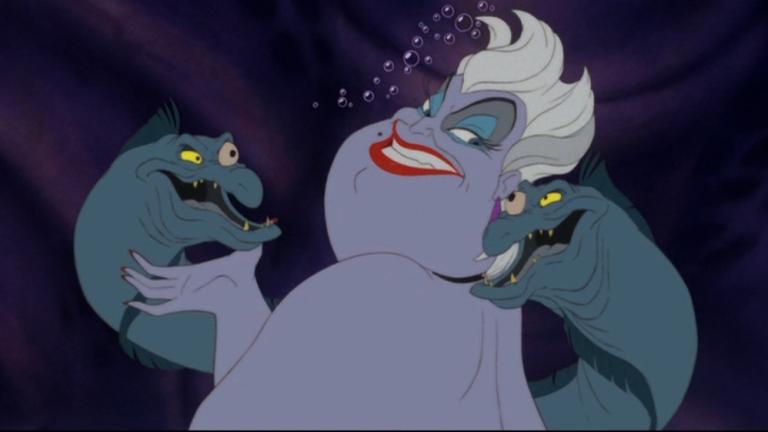
ursulaHere, the movie shifts slightly fromParadise Lost to Faust: Ursula promises to give Ariel everything she longs for in return for her voice. If Ariel can make Eric fall in love with her, then she gets to keep her legs. And if she can’t get that to happen in three days (another little biblical echo there), Ariel’s soul belongs to the sea witch.
Ariel gets her legs. Unable to stay underwater, she essentially casts herself out of the garden—and must go to a much drier, harsher world filled with (as Sebastian has warned us) pain, labor and fish-eaters.
Now, Disney doesn’t make this topside look all bad, of course. Eric’s palace isn’t exactly a sweat shop. But the fact remains that Ariel has been exiled from paradise to … somewhere else; another home that isn’t really her home. She’s a fallen mermaid, if you will. And when mermaids fall, they fall up—to an equally fallen world.
Ursula will make sure that Ariel will stay fallen. She plots and schemes and directly interferes with Ariel’s own designs until the third day’s up. There’s only one way, it seems, for Ariel to escape her fate as another soul in Ursula’s collection of them. Someone will have to take her place. And in a very New Testament twist, that someone is Ariel’s own godlike father, Triton. He gives his own life for that of his child … even though she got herself in trouble through her own disobedience.
Now, it’s here where this vaguely spiritual string of metaphors kinda breaks apart, what with Eric spearing Ursula’s midsection with a ship and all. But that doesn’t change the fact that The Little Mermaid is a story of redemption: Ariel doesn’t return to her watery paradise, but through grace and sacrifice, she’s no longer a completely fallen creature, either. She was saved, quite literally, and in the end finds happiness even in her fallen state, and as apart of a fallen world, because she knows her Daddy loves her—loves her enough to sacrifice everything for her.
I think it holds a little bit of water … don’t you?

Wednesday, May 28, 2014

Who's the Evilest of Them All?

Walt Disney always knew the value of a good villain.

Maleficent, who haughtily strides into theaters Friday in the guise of Angelina Jolie, is proof of that. This self-proclaimed "Mistress of All Evil" is Disney's most dastardly diva, a woman who could teach Star Wars' dark Emperor a thing or two about fashion and eat Hannibal Lector for breakfast (as a dragon, quite literally). Maybe it's the horns. The evil raven. The fact that her very name seems to mean something like "magnificently bad" (if we're liberal with our Latin/English construction). Clearly, even her parents knew she was up to no good.

Rumor has it that she cuts a more sympathetic figure in this newest of Disney flicks, but part of me hopes that they don't mess with the lady too much. It's nice to have someone to root against—even if it's not always fair.

See, the problem with evil (well, one of the many, many problems with evil) is that it's often quite sneaky. We like to think of it in our stories as something outside of us—something other and ugly and monstrous. But unfortunately, what we think of as evil is really just good twisted up. The ol' Latin prefix of "mal" suggests as much. Our cars malfunction. Our wayward kids are maladjusted. Our bosses are malicious. It suggests that something that once worked just fine broke along the way. It's not right anymore.

We Christians believe that break happened at the very beginning of the world, when sin entered into it and led us all astray. And we're also taught that we all are prone to sin, which means we're all a little broken, too. We've got a malady in us.

We don't like to think about that. We're all the heroes of our own stories, after all. By default, that makes us the good guys. We're Sleeping Beauty and Prince Charming, right? There's no Maleficent in us.

But of course there is. And maybe, just maybe, some of these outward manifestations of evil help us see the darker corners of our own souls.

So with that in mind, here's a completely subjective countdown of my five favorite Disney animated villains—and just what they might be able to teach us, too.

5. Captain Hook. For all his faults, I've always respected the sense of style of Peter Pan's main villain. Not everyone can pull off a hat like that. And honestly, I've always felt a little sorry for the guy. After all, we all might harbor some bitterness if someone fed one of our hands to a crocodile—which, we're told, is exactly what Peter Pan did. (If I was Pan's dad, I would've told him that it's never OK to feed other people's body parts to reptilian carnivores, no matter what.) But where Hook goes awry is that he never, ever lets that misdeed go. He has vowed revenge on Pan for that crocodile snack, no matter how long it takes—and in a place called Never Neverland, that could be a mighty long grudge. Hook's obsession with Pan is a good reminder that forgiveness is an important and healthy aspect of our faith—even when it's really, really hard to forgive.  

4. The Coachman. Pinocchio has so many fantastically bad characters that it's hard to settle on just one: "Honest" John, Stromboli, Monstro the whale … but since I'm morally opposed to whaling and have the upmost respect for puppeteers, I'd like to focus on the Coachman, the rotund fellow who takes Pinocchio off to Pleasure Island. He's the worst kind of villain—a guy who misleads the innocent and then turns them all into donkeys afterwards. For me, the guy's a pretty potent symbol of our own inclinations to slip into temptation and excuse our own bad behavior. We don't need a coachman to take us to Pleasure Island. Most of us can walk there all on our own.

3. The Wicked Queen. The queen in Snow White is Maleficent 1.0, and even after more than 80 years, she's still a potent symbol of evil. But in her own way, she's a dramatic and still jarring zag away from how we typically think of evil. See, we humans have a bias toward beauty. Even modern-day studies suggest that we're more prone to believe pretty people than ugly ones. But here, the evil is found in this uber-glamorous queen (love that black cowl thingy she's got going for her). It's only when she "disguises" herself as an old crone that we see her true nature. And why does she change? Jealousy, plain and simple. The Queen decides to have Snow White killed because her mirror told her that she was prettier than she was. We can all feel a little jealous at times: Someone's always, it seems, a little prettier or stronger or smarter than we are. Sometimes we all need to be reminded that, in God's eyes, we're pretty awesome. If only someone would've told the Queen that true beauty is found on the inside, well, we might've saved a handful of dwarves a lot of angst (though their cottage would probably still be filthy).

2. Chernabog. Of all the Disney villains on the list, Chernabog—the demon at the end of Fantasia—is the only one I actually had nightmares about as a kid. This guy was as bad as they come, what with all the ghosts circling his head and the weird goblins he dumps into the fire and all. He's got claws and wings and the nastiest of scowls. He scared the dickens out of me, and I don't mean Charles. But here's a funny thing about we mortals: The things that scare or repulse us are sometimes the same things that we can be attracted to, sometimes unhealthily so. As a kid, I couldn't get Chernabog out of my mind. I didn't want to be the guy … and yet, the power that he wielded at the top of that mountain was, in a way, pretty enticing to a little boy who went to bed at 8 p.m. No one would make that winged demon eat his beats, that's for sure. Power  can be an, um, powerful temptation for some. And while power in itself isn't all bad (my editor certainly wouldn't think so), it can lead us down some dark, even diabolical paths.


1. Maleficent. If she wants to call herself the Mistress of All Evil, who am I to argue? While she may find a measure of redemption in the new movie, she's really, really bad in Sleeping Beauty—as in a servant-of-the-devil bad. I don’t think it's any accident that Prince Phillip fights the ol' girl with the Sword of Truth and the Shield of Virtue—an echo, perhaps, of Paul's "Armor of God" passage in Ephesians 6. (The shield even has a Christian cross emblazoned on it.) Clearly, Maleficent made some bad choices in her life. But maybe she would've been in a position to make better choices had she, I dunno, not spent her time alone (goblin henchmen don't count) in a castle surrounded by thorns (yes, yes, you know-it-all Disney watchers, the thorns came later. Just go with me here. We're speaking metaphorically.)  I think that maybe, had she spent a little more time with her fellow fairies, she might've turned out differently. Life and faith, after all, are meant to be lived in community. We need people to tell us when we're getting a little, um, weird. And perhaps, with a little more companionship, someone might've ventured to tell her that the whole horned hat thing was a bad fashion choice.

Monday, February 4, 2013

Paperman: God is My Paper Airplane Co-Pilot

Cartoons should be seen, not heard.

That seems to be the philosophy for short animation films these days. "Forget dialogue," animators seem to say. "Let's tell a story with just pictures and movement and maybe a little music. Who needs those stinkin' words?!" 

And they've got a point. I mean, the folks who craft these moving works of art are ... well, artists. They've been trained to talk through image. And when we see Pixar's amazing short films (most of which are wordless) or "The Master," which I blogged about last year, words seem superfluous--even distracting. These artists understand what we sometimes forget (particularly us writers): The most profound, most powerful moments often come unaccompanied by syllabic flotsam. Words just get in the way.

Take a look, for example, at "Paperman"--a short by Disney that's been nominated for an Academy Award for Best Short Film (Animated). Just six minutes long and presented in gloriously rich black and white, it still conveys a world of emotion.

Nifty, ain't it? It needs not a single word of explanation but is still filled with promise and regret and tension and magic. No back story needed. No subtext required. It's a  gem to be appreciated simply for what it is.

And yet, it also sticks with you. And maybe in its wordless way, it propels you along an unexpected line of thinking.

"Paperman" obviously wasn't designed to be a spiritual illustration. And yet it could be--on the strange, mysterious way in which some of us feel God works in our lives. 

Look at the man again, throwing his pile of paper airplanes. All his work and toil (and perhaps painful papercuts) seem to come to naught. But then, the airplanes themselves seem to pick up the cause, mysteriously forcing these two would-be lovers together. The planes lead, encourage, even flirt. And when the man seems bent on going another way, they physically force the guy to move toward his destiny.

I've interviewed a lot of folks who feel as though God has "told" them what to do--that He pushed them to perform a certain task or take up a certain job or give a certain gift. "I didn't want to do it," they sometimes tell me. "I had no intention of doing it. But it became so obvious that that's what God wanted me to do." It's as if God's paper planes surrounded them and pushed them along.

Now, I've always treated these stories with a certain skepticism, maybe because I've never really been there--never felt so obviously "pushed" by God. I have no burning bushes or talking donkeys in my backlog of memories. I've never heard God tell me to do something. Never felt Him manipulate me like a Ouija pointer to a pre-determined course. Oh, don't get me wrong: I've felt God's presence in my life (or I feel as though I've felt Him), but when it comes to big decisions--to leave an old job or capitalize on a new opportunity or take a grand leap of faith--God grows silent. 

Or perhaps not. Maybe He, like the film "Paperman" itself, speaks to me without speaking  ... His influence quiet but inexorable, graceful but unmistakable. After all, He knows us all so well. Maybe He knows (just like my wife knows) that I don't like to be told what to do. Maybe He speaks to us in tailored language, communicating what we need to hear in ways we best understand. 

Maybe God knows that, for some reason, I need my illusion of control. That I need to make my paper airplanes. And that the beauty of faith for me isn't so much in certainty--a call from God by bullhorn--but in mystery. To watch my planes float through the air, wondering where an unseen hand might take them.