Showing posts with label star wars. Show all posts

Sunday, December 20, 2015

‘Star Wars: The Force Awakens’ Gets Spiritual


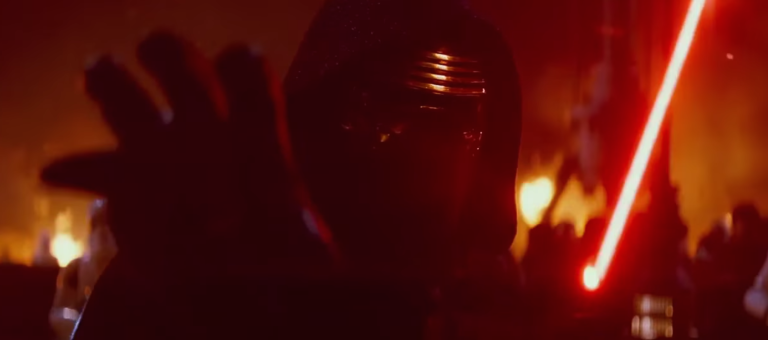
Screen Shot 2015-12-16 at 2.34.24 PM
Kylo Ren, from Star Wars Episode VII: The Force Awakens. Photo from the trailer, courtesy Disney
Republished from my Watching God blog on Patheos.
Kylo Ren isn’t all that he pretends to be.
When we first meet him in Star Wars Episode VII: The Force Awakens, Ren (played by Adam Driver) is doing his best to look, sound and act just like his idol, Darth Vader. He wears a fearsome black mask. He has a seriously wicked-looking red light sabre. He can telepathically choke people like nobody’s business. Like Vader, he serves as a spiritual leader to a galactic power—the First Order, an organization that resembles the old Empire but with a dash of ISIS-like zealotry thrown in the mix.
But perhaps Ren’s more like Vader than he even knows. That mask hides confusion, uncertainty. Maybe he’s not completely the plaything of the Dark Side just yet. And Lor San Tekka (Max Von Sydow) does his best to tease Ren back to the Light.
“The First Order came from the Dark Side,” San Tekka says. “You did not.”
It’s a deceptively powerful bit of theology thrown in the movie’s opening minutes. But maybe that’s not too surprising from a franchise that has boldly embraced spirituality from the very beginning.
The Star Wars universe has always been predicated on the Force. “ Life creates it, makes it grow,” Yoda says in The Empire Strikes Back. “Its energy surrounds us and binds us. Luminous beings are we, not this crude matter. You must feel the Force around you; here, between you, me, the tree, the rock, everywhere, yes. Even between the land and the ship.” And while The Phantom Menace seemed to suggest that this cosmic power could be explained by microscopic midi-chlorians—the more midi-chlorians you had, the more the Force was strong in you—The Force Awakens leans into more of a spiritual understanding. People talk reverently, almost lovingly about it, and even an old skeptic like Han Solo (Harrison Ford) seems to be a convert.
“The Force, Jedi, all of it,” he says. “It’s all true.”
That Force is divided between dark and light—warring elements that, paradoxically, exist in eternal balance. Folks like Luke Skywalker and Obi Wan Kenobi are able to tap into the positive energy of the Force. Vader and Kylo Ren seem to have a yen for the Dark Side.
These basic elements aren’t Christian, of course. Concepts like the Force and that sense of light/dark dualism owes a lot, I think, to Taoism, Zoroastrianism and perhaps a few other isms besides. But that said, how the Force manifests itself can feel pretty familiar to Christians like me.
When Taoism speaks of “light” and “dark” being in balance, it’s a lot more like the day/night, sun/moon, male/female sense of light and dark. But in Star Wars, darkness is plainly and irredeemably evil—not something anyone should really gravitate to, balance or no. You’ve got good guys, you’ve got bad guys. There’s no moral equivalency between them.
And here’s another interesting thing: The Dark Side of the Force is all about temptation: It’s not more powerful than the Light, but it is “quicker, easier, more seductive,” according to Yoda. The Dark Side is all about giving into your worst impulses. “Give into your hate,” the Emperor tells Luke. “With each passing moment you make yourself more my servant.” To follow the Light means exerting control on your own urges. The Dark Side merely asks for its acolytes to give themselves over to them.
Sounds an awful lot like sin to me.
But the Light has its own pull, too—and we see Kylo Ren struggle with its attractions. At one point, Ren addresses the crumpled, burnt mask of Darth Vader almost as if he was praying to a Catholic relic. “Forgive me,” he tells it. “I feel it again. The call to the Light.” And while the Light isn’t as sexy as the Dark, it appeals to Ren on a different level.
See, like Ren, we Christians believe we weren’t made to be creatures of the Dark Side. We were made by God in His image, to be reflections of His glory. Alas, sin has pulled us out of the Light. We make mistakes, we long for the wrong things, we give into our worst inclinations sometimes. But the Light still calls us always. I think most of us feel His pull. Our temptations and sins—gifts of God twisted beyond recognition—came from the Dark Side. But we did not.
And like Christianity, Star Wars tells us that it’s never too late to find the Light, to find a better way forward. Darth Vader, as terrible as he was, found redemption in the end—salvation through sacrifice. Pretty resonant stuff.
Kylo Ren wants to follow the Dark Side. If the mask wasn’t clue enough, he makes it pretty clear at the beginning of The Force Awakens. But the Light hasn’t given up on him. Just like it hasn’t on us.

Tuesday, July 1, 2014

There’s an Alien On My Church

Exploring links between pop culture and spirituality has been my thing for a few years now. And most of the time, it’s sort of a one-way street. I look at a piece of entertainment and try to find a little hint of God or faith at work in them. But it can go the other way, too. Pop culture can sneak into church—sometimes quite literally.

Take the Bethlehem Chapel (Chapelle de Bethleem), a church built in Brittany in the Middle Ages and declared a historical monument in 1911.


Looks like a pretty typical, pretty old church, right? But despite the chapel’s antiquity, it boasts some rather unusual, eye-catching gargoyles on its corners. For example, this one.


And this.


And this.


What, were the original builders time travelers with an affection for 1980s American cinema? If only. No, the explanation is a little more pedestrian (but still pretty interesting). When the chapel was being restored in 1993, there was some question as to how to replace the missing pinnacles at the corners. So sculpture Jean-Louis Boistel proposed to craft gargoyles (or, more correctly, the chimeras) that blended mythological, Christian and contemporary references into a solid whole.

So, in addition to Adam and Eve and symbols of the Four Evangelists, Boistel incorporated the alien from Alien (representing the biblical Leviathan), the gremlins from Gremlins (symbolizing the good and evil in ourselves) and Goldorak—a manga knight that was apparently super-popular in France back in the mid 1990s (representing righteousness). You can see the Boistel’s Goldorak here.


But the Bethlehem Chapel isn’t the only place you can find pop culture iconography on the outside of a church. Take a look at this picture from the National Cathedral in Washington D.C. and you might see a certain Sith Lord staring down at you.


Maybe to some, these entertainment figurines seem like a strange fit with the eternal truth held inside the church. The idea of Gizmo gracing a centuries-old sanctuary might feel a little too flip.


But I don’t think so. Throughout its history, the Christian Church has shown a remarkable ability to adapt what’s popular and translate it into something holy. It co-opted pagan holidays and made them sacred. It adopted popular drinking songs and made them hymns. To me, these carvings are simply another example of the Christian ability to sanctify the less-than-pure stuff in our culture. Which, when you think about it, is really core to the faith itself. After all, we less-than-perfect Christians also believe we’ve been redeemed. Kinda nifty, that.  

Tuesday, January 22, 2013

Star Wars: Bad Prequels (But Better Theology?)

I was listening to the Strangers and Aliens podcast while running this afternoon, and I was thrilled to hear them discussing one of my favorite topics: Star Wars.

The gist of the podcast was discussing all the many questionable stepchildren that the success of Star Wars spawned, slating them as either of "the light side" or "the dark side." The revival of the Star Trek franchise was given light-side status, while Moonraker--James Bond's worst movie ever--was justifiably banished to the Dark Side. But the topic really got me thinking about another massively important product of Star Wars: Me.

I was 8 when Star Wars came out (that's be Star Wars IV: A New Hope to some of you), and George Lucas' little creation was nothing short of a revolution to my little world, which before then had primarily revolved around reading, collecting rocks and smashing glass. (I grew up in Taos, N.M., which, despite being very artsy then and now, was a pretty boring place for non-artsy, non-sportsy kids.)

But when I saw Star Wars, my whole life changed. I became obsessed with the movie and forced my parents to take me to see it five times (remember, these were the days before we, in Taos, had ever heard of a VCR). I dreamed I was Luke Skywalker. We were too poor to buy Star Wars action figures, so I made my own out of cardboard. (My Millennium Falcon was the most pitiful-looking spacecraft ever.) It was the first movie I ever fell in love with.

My fascination with Star Wars was tolerated around my house for the most part. And, several years later, when an expert on the Star Wars universe came to visit the family church about the time Return of the Jedi was released, I found myself looking forward to going to church for the first time in years.

Imagine my disappointment when the guest speaker announced that Star Wars--my beloved, earth-shaking franchise--was awash in dualism and eastern spirituality and thus incompatible with Christianity.

These theologians. Can't they leave anything alone?

I suppose my research in trying to prove this cat wrong might've been the impetus to my long, weird and still puzzling road to that of a Christian movie reviewer. Now I'm the guy who warns Christian parents about Star Wars' quasi-spiritual underpinnings--though I'd like to think I'm a bit more open-handed about it all. "In The Force, we can see hints of Zoroastrianism and Taoism," I might say. "But man, are those light-sabers awesome or what?!"

Truth is, I have a hard time believing that watching Star Wars is a faith-shaking event for most of us (the 390,000 U.K. residents who list "Jedi" as their faith of choice notwithstanding). But still, the religiously wonky side of me did appreciate the spiritual underpinnings of the recent prequels, even if the movies themselves were pretty meh. Yes, the Force in the Star Wars universe still, as Yoda says, "surrounds us and binds us." It has its light side and dark side. But the core story we see in the prequels (The Phantom Menace, Attack of the Clones and Revenge of the Sith) is an echo to the Fall of Adam and Eve.

Anakin Skywalker is tempted by the future emperor and his powerful "Dark Side" of the force--a form of forbidden knowledge, really--just as Adam and Eve were tempted by the fruit from the Tree of Knowledge. Both of these deeply rebellious acts set narratives in motion that required a miraculous intervention to fix. And even though I hated Jar Jar Binks as much as anyone, I found the redemption of Darth Vader--in some ways, a stand-in for all us miserable sinners--more moving because I better understood his backstory.

There's more to say on this topic, of course. But that'll have to wait. But now you have one more thing to curse George Lucas for: The creation of an overly interpretive, religiously oriented movie reviewer.